
When you buy a used copy YOU SAVE
Carbon Dioxide
0.95Kg of CO2
Water
119 litre(s) of Water
Tree
0.0071 Tree(s)
donate
1 book donated to global literacy projects

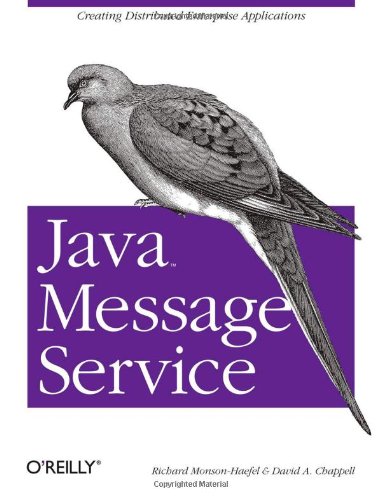
Java Message Service (Java series)
3.60 ( 77 Ratings by Goodreads)
Java Message Service (Java series)

Java Message Service (Java series)

3.60 (77 Ratings by Goodreads)
paperback
Published: 4 December, 2000
Standard worldwide delivery by Fri, July 17 - Wed, July 22
Order within 0
Condition: USED
$10.69
RRP $41.47
You save $30.77 (74%)
Price includes shipping
Available 2 in stock
- +
FREE Returns within 30 days

Description

This text provides an introduction to Java Message Service (JMS), the standard Java application program interface (API) from Sun Microsystems that supports the formal communication known as "messaging" between computers in a network. JMS provides a common interface to standard messaging protocols and to special messaging services in support of Java programs. The messages exchange crucial data between computers, rather than between users - information such as event notification and service requests. Messaging is often used to co-ordinate programs in dissimilar systems or written in different programming languages. Using the JMS interface, a programmer can invoke the messaging services of IBM's MQSeries, Progress Software's SonicMQ, and other popular messaging product vendors. In addition, JMS supports messages that contain serialized Java objects and messages that contain Extensible Markup Language (XML) pages. Messaging is a powerful new paradigm that makes it easier to uncouple different parts of an enterprise application. Messaging clients work by sending messages to a message server, which is responsible for delivering the messages to their destination. Message delivery is asynchronous, meaning that the client can continue working without waiting for the message to be delivered. The contents of the message can be anything from a simple text string to a serialized Java object or an XML document. Java Message Service shows how to build applications using the point-to-point and publish-and-subscribe models; how to use features like transactions and durable subscriptions to make an application reliable; and how to use messaging within Enterprise JavaBeans. It also introduces a new EJB type, the MessageDrivenBean, that is part of EJB 2.0, and discusses integration of messaging into J2EE.
See more

More Details

Type Book
ISBN13 9780596000684
ISBN10 0596000685
Number Of Pages 238
Item Weight 407 g
Product Dimensions 178 x 15 x 231 mm
Publisher / Reseller O'Reilly Media
Format paperback
Edition 1
See More +

Author's Bio

Richard Monson-Haefel is a leading expert in Enterprise Java development. He is the architect of OpenEJB, an open source EJB server, and has consulted as an architect on Enterprise JavaBeans, CORBA, Java RMI, and other distributed computing projects over the past several years. Richard is also the author of O'Reilly's Enterprise JavaBeans. Dave Chappell is vice president and SonicMQ chief technology evangelist at Progress Software Corp. Dave has over 18 years of industry experience building software tools and infrastructure for application developers, spanning all aspects of R&D, sales, marketing, and support services. Dave has also been published in Network World magazine and has presented technical topics at numerous speaking engagements including JavaOne and XMLOne. As director of engineering for SonicMQ, Progress Software's award winning JMS Internet Commerce Messaging System, Dave oversaw the design and development of the fastest and most scalable, reliable, and robust implementation of JMS in the marketplace. Dave has under his belt a broad cross-platform background in designing and developing Internet based middleware and distributed object systems across a wide range of technologies including C++, Java, DCOM, CORBA, and EJB. Dave's experience also includes development of client/server infrastructure, graphical user interfaces, language interpreters, and various utility libraries.

Show more