Tweeting the Universe :Tiny Explanations of Very Big Ideas
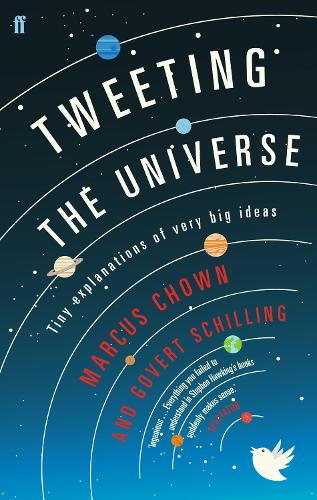
Tweeting the Universe :Tiny Explanations of Very Big Ideas
paperback
Published:
7 March, 2013

Popular Books by Govert Schilling
View All Books by Govert Schilling

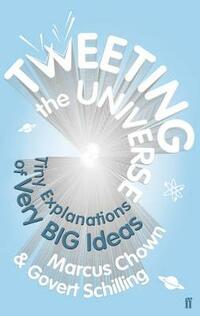
Description
In 140 pages, two masterly popularisers present 140 explanations of the biggest questions in physics - in the form of 10 or so tweets per page. They set themselves the challenge of boiling down what is essential on each subject into sentences of 140 characters, and the results are both entertaining and brilliantly informative. Not a word is wasted. The reader is not patronized and learns something on every page. If only all science writing could be so precise and so economical.
Only science writers of a very high calibre could achieve such compression. Marcus Chown - 'the finest cosmology writer of our day' (Matt Ridley) - has known the Dutch writer Govert Schilling for twenty years. Schilling pioneered this very swift form of explanation in a Dutch newspaper, and suggested to Chown that they collaborate on bringing it to a wider audience. Tweeting the Universe is unlike any other science book.
More Details
| Type | Book |
|---|---|
| ISBN13 | 9780571295708 |
| ISBN10 | 0571295703 |
| Number Of Pages | 336 |
| Item Weight | 260 g |
| Product Dimensions | 126 x 198 x 21 mm |
| Publisher / Reseller | Faber & Faber |
| Format | paperback |
| Edition | Main |
Author's Bio
Marcus Chown is the author of the bestselling Quantum Theory Cannot Hurt You, The Never Ending Days of Being Dead and The Magic Furnace. He is the cosmology consultant for New Scientist. He also wrote The Solar System, the bestselling app for iPad, which won the Future Book Award 2011.
Govert Schilling has published widely on astronomical topics. Three of his books have been translated into English: The Hunt for Planet X, Evolving Cosmos and Flash!. The International Astronomical Union named Asteroid 10986 Govert after him in recognition of his work on popularizing science.