
1.02Kg of CO2

128 litre(s) of Water

0.0077 Tree(s)

1 book donated to global literacy projects
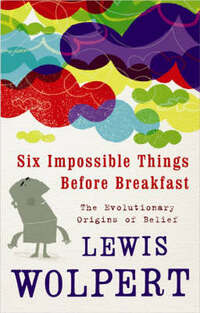
Six Impossible Things Before Breakfast :The Evolutionary Origins of Belief

Six Impossible Things Before Breakfast :The Evolutionary Origins of Belief
paperback
Published:
4 January, 2007


Popular Books by Lewis Wolpert
View All Books by Lewis Wolpert








Description
Why does every society around the world have a religious tradition of some sort? Professor Lewis Wolpert investigates the nature of belief and its causes. He looks at belief's psychological basis and its possible evolutionary origins in physical cause and effect.
Wolpert explores the different types of belief - including that of animals, of children, of the religious, and of those suffering from psychiatric disorders. And he asks whether it is possible to live without belief at all, or whether it is a necessary component of a functioning society.
More Details
| Type | Book |
|---|---|
| ISBN13 | 9780571231683 |
| ISBN10 | 0571231683 |
| Number Of Pages | 256 |
| Item Weight | 205 g |
| Product Dimensions | 127 x 197 x 16 mm |
| Publisher / Reseller | Faber & Faber |
| Format | paperback |
| Edition | Main |
Media Reviews
"'Brilliant and persuasive search for the source of our need to believe.' Sunday Times"
Author's Bio
Lewis Wolpert is a distinguished embryologist and an accomplished broadcaster. He is Professor of Biology as Applied to Medicine at University College, London, and has taken part in numerous radio programmes, particularly interviews with other scientists. A CBE and a Fellow of the Royal Society, he was chairman of the Committee on the Public Understanding of Science for four years. He is the author of A Passion for Science and Passionate Minds (with Alison Richards), and The Triumph of the Embryo. For Faber, he has written The Unnatural Nature of Science.