
3.09Kg of CO2

386 litre(s) of Water

0.0232 Tree(s)

1 book donated to global literacy projects
Thermal Sciences :An Introduction to Thermodynamics, Fluid Mechanics, and Heat Transfer (with CD ROM)
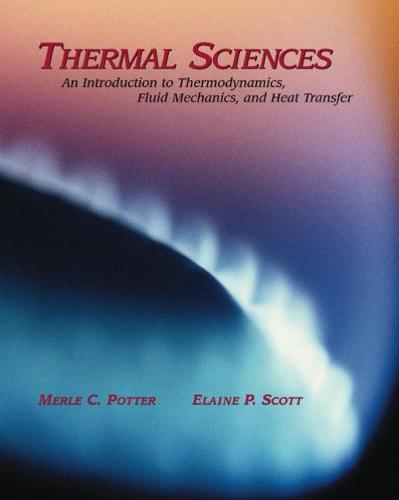
Thermal Sciences :An Introduction to Thermodynamics, Fluid Mechanics, and Heat Transfer (with CD ROM)
other
Published:
29 May, 2003


Popular Books by Merle Potter
View All Books by Merle Potter
Description
More Details
| Type | Book |
|---|---|
| ISBN13 | 9780534385217 |
| ISBN10 | 0534385214 |
| Number Of Pages | 772 |
| Item Weight | 1500 g |
| Product Dimensions | 212 x 240 x 37 mm |
| Publisher / Reseller | Cengage Learning, Inc |
| Format | other |
| Edition | New edition |
Media Reviews
Part 1: THERMODYNAMICS. 1. CONCEPTS, DEFINITIONS, AND BASIC PRINCIPLES. Introduction. Thermodynamic Systems and Control Volumes. Macroscopic Description. Properties and State of a System. Equilibrium Processes and Cycles. Units. Density, Specific Volume, Specific Weight. Pressure. Temperature. Energy. 2. PROPERTIES OF PURE SUBSTANCES. Introduction. The p-T-v Surface. The Liquid-Vapor Region. Steam Tables. Equations of State. Equations of State for a Nonideal Gas. Summary. 3. WORK AND HEAT. Introduction. Definition of Work. Quasiequilibrium Work Due to a Moving Boundary. Nonequilibrium Work. Other Work Modes. Heat Transfer. Summary. 4. THE FIRST LAW OF THERMODYNAMICS. Introduction. The First Law of Thermodynamics Applied to a Cycle. The First Law Applied to a Process. Enthalpy. Latent Heat. Specific Heats. The First Law Applied to Various Processes. General Formulation for Control Volumes. Applications of the Energy Equation. Transient Flow. The First Law with Heat Transfer Applications. 5. THE SECOND LAW OF THERMODYNAMICS. Introduction. Heat Engines, Heat Pumps, and Refrigerators. Statements of the Second Law of Thermodynamics. Reversibility. The Carnot Engine. Carnot Efficiency. Entropy. Entropy for Ideal Gas with Constant Specific Heats. Entropy for Ideal Gas with Variable Specific Heats. Entropy for Substances such as Steam, Solids, and Liquids. The Inequality of Clausius. Entropy Change for an Irreversible Process. The Second Law Applied to a Control Volume. 6. POWER AND REFRIGERATION VAPOR CYCLES. Introduction. The Rankine Cycle. Rankine Cycle Efficiency. The Reheat Cycle. The Regenerative Cycle. Effect of Losses on Power Cycle Efficiency. The Vapor Refrigeration Cycle. The Heat Pump. 7. POWER AND REFRIGERATION GAS CYCLES. Introduction. The Air Standard Cycle. The Carnot Cycle. The Otto Cycle. The Diesel Cycle. The Brayton Cycle. The Regenerative Gas-Turbine Cycle. The Combined Rankine-Brayton Cycle. The Gas Refrigeration Cycle. 8. PSYCHOMETRICS. Introduction. Gas-Vapor Mixtures. Adiabatic Saturation and Wet-Bulb Temperatures. The Psychometric Chart. Air-Conditioning Processes. 9. COMBUSTION. Combustion Equations. Enthalpy of Formation, Enthalpy of Combustion, and the First Law. Adiabatic Flame Temperature. Part 2: FLUID MECHANICS. 10. BASIC CONSIDERATIONS. Introduction. Dimensions, Units, and Physical Quantities. Continuum View of Gases and Liquids. Pressure and Temperature Scales. Fluid Properties. Conservation Laws. Thermodynamic Properties and Relationships. 11. FLUID STATICS. Introduction. Pressure at Point. Pressure at Variation. Fluids at Rest. Linear Accelerating Containers. Rotating Containers. 12. INTRODUCTION TO FLUIDS IN MOTION. Introduction. Description of Fluids in Motion. Classification of Fluid Flows. The Bernoulli Equation. 13. THE INTEGRAL FORMS OF THE FUNDAMENTAL LAWS. Introduction. The Three Basic Laws. System-to-Control-Volume Transformation. Conservation of Mass. Energy Equation. Momentum Equation. 14. DIMENSIONAL ANALYSIS AND SIMILITUDE. Introduction. Dimensional Analysis. Similitude. 15. INTERNAL FLOWS. Introduction. Enhanced Flow and Developed Flow. Laminar Flow in a Pipe. Laminar Flow Between Parallel Plates. Laminar Flow Between Rotating Cylinders. Turbulent Flow in a Pipe. Uniform Turbulent Flow in Open Channels. 16. EXTERNAL FLOWS. Introduction. Separation. Flow Around Immersed Bodies. Lift and Drag on Airfoils. Potential Flow Theory. Boundary Layer Theory. 17. COMPRESSIBLE FLOW. Introduction. Speed of Sound and the Mach Number. Isentropic Nozzle Flow. Normal Shock Wave. Shock Waves in Converging-Diverging Nozzles. Oblique Shock Wave. Isentropic Expansion Waves. APPENDIX. ANSWERS TO SELECTED PROBLEMS. INDEX.
Author's Bio
Dr. Merle C. Potter holds a B.S. in Mechanical Engineering and an M.S. in Engineering Mechanics from Michigan Technological University, as well as an M.S. in Aerospace Engineering and a Ph.D. in Engineering Mechanics from the University of Michigan. Dr. Potter taught for 40 years, including 33 of years at Michigan State University where he taught thermodynamics, fluid mechanics and numerous other courses. Dr. Potter has authored and co-authored 35 textbooks, help books, and engineering exam review books. He has specialized in fluid flow stability and energy research. He has received numerous awards, including the Ford Faculty Scholarship, the Teacher-Scholar Award, the ASME Centennial Award, the MSU Mechanical Engineering Faculty Award, and the James Harry Potter Thermodynamics Gold Medal. Dr. Potter is a member of ASEE, ASME, and the American Academy of Mechanics. Elaine P. Scott received her Ph.D. from Michigan State University and is a Professor at Virginia Tech. Her teaching responsibilities include Introduction to Thermal Fluids and Fundamentals of Thermodynamics. Dr. Scott's research projects include thermal waves in heterogeneous materials, development of noninvasive probe to measure blood perfusion, IPEM Synthesis Thermal Thrust, and microwave related research.