Random Networks for Communication :From Statistical Physics to Information Systems - Cambridge Series in Statistical and Probabilistic Mathematics
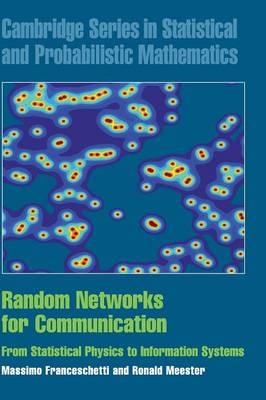
Random Networks for Communication :From Statistical Physics to Information Systems - Cambridge Series in Statistical and Probabilistic Mathematics
hardback
Published:
10 January, 2008

Popular Books by Massimo Franceschetti
View All Books by Massimo Franceschetti
Description
More Details
| Type | Book |
|---|---|
| ISBN13 | 9780521854429 |
| ISBN10 | 0521854423 |
| Number Of Pages | 212 |
| Item Weight | 550 g |
| Product Dimensions | 178 x 259 x 16 mm |
| Publisher / Reseller | Cambridge University Press |
| Format | hardback |
Media Reviews
'The balance between intuition and rigor is ideal, in my opinion, and reading the book is an enjoyable and highly rewarding endeavor … this book will be useful to physicists, mathematicians, and computer scientists who look at random graph models in which point locations affect the shape and properties of the resulting network: physicists will acquaint themselves with complex networks having rich modeling capabilities (e.g. models for random interaction particle systems such as spin glasses), mathematicians may discover connections of the networks with formal systems (much like the connection of the classical Erdős–Rényi random graph properties with first- and second-order logic), and computer scientists will greatly appreciate the applicability of the theory given in the book to the study of realistic, ad hoc mobile networks in which network node connections change rapidly and unpredictably as a function of the geometry of the current node positions.' Yannis Stamatiou, Mathematical Reviews
Author's Bio
Massimo Franceschetti is assistant professor of electrical engineering at the University of California, San Diego. His work in communication system theory sits at the interface between networks, information theory, and electromagnetic wave propagation. Ronald Meester is professor of mathematics at the Vrije Universiteit Amsterdam. He has published broadly in percolation theory, spatial random processes, self-organized criticality, ergodic theory, and forensic statistics and is the author of Continuum Percolation (with Rahul Roy) and A Natural Introduction to Probability Theory.