
0.9Kg of CO2

112 litre(s) of Water

0.0067 Tree(s)

1 book donated to global literacy projects
Turn Left at Orion: A Hundred Night Sky Objects to See in a Small Telescope - and How to Find Them
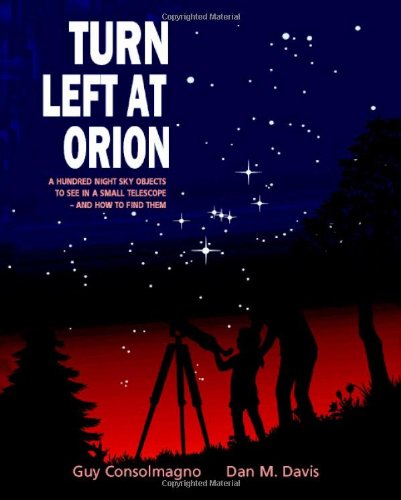
Turn Left at Orion: A Hundred Night Sky Objects to See in a Small Telescope - and How to Find Them
hardback
Published:
19 October, 2000


Popular Books by Guy Consolmagno
View All Books by Guy Consolmagno
Description
More Details
| Type | Book |
|---|---|
| ISBN13 | 9780521781909 |
| ISBN10 | 0521781906 |
| Number Of Pages | 224 |
| Item Weight | 1078 g |
| Product Dimensions | 222 x 24 x 278 mm |
| Publisher / Reseller | Cambridge University Press |
| Format | hardback |
| Edition | 3 |
Media Reviews
'Wonderful ... it is one of those books about which you say, 'If only I had something like this when I was a beginner'.' Journal of the Astronomical Society of the Pacific
'This is a GREAT BOOK! ... This book is unique, with easy, clear directions on how to find these celestial objects, the best conditions, and what you will see. Consolmagno and Davis do a terrific job.' Colin Haig, Event Horizon, Hamilton (Ontario) Amateur Astronomers Newsletter
'No telescope owner should be without this classic (now updated) amateur astronomy manual.' Jamie Love, Science Explained
'Turn Left at Orion has all the qualifications of a good beginner's guidebook. It makes observing deep-sky objects easier, and most of the objects listed can be seen from the city. More importantly, it makes observing FUN!' Kathy Anderson, The Reflector, The Astronomical League Newsletter
'Turn Left at Orion is the most user friendly field guide I have ever come across.' The Eyepiece
'When and if you buy that first telescope, you should get Turn Left at Orion' . Newsletter of the Battle Point Astronomical Association
'If you have difficulty finding objects, perhaps the person who gave you the telescope forgot to give you a good set of star maps. I'd recommend Turn Left at Orion. With it and a telescope of practically any size, you'll find plenty to see.' Tom Burns, Director, Perkins Observatory, Ohio Wesleyan University
'This book is really a must have!' Bob Martino, Perkins Observatory, Ohio Wesleyan University
'This book is an ideal catalog of just the kinds of wonders in the sky that we like to show the public in any of the telescopes at our AAAA public star parties ...' Newsletter of the Ames (Iowa) Area Amateur Astronomers
'Should be packaged with every first telescope ...' Chet Raymo, Sky and Telescope
'Stars all look pretty much the same, but this book tells you how to find unusual, deep-sky objects, such as the ring Nebula, which looks like a perfect smoke ring. Other guides simply don't provide this. Part of the excitement of astronomy is finding things; this book is invaluable.' Tom Parker, The Times
'I think the format is perfect for beginners but even more advanced observers may learn a thing or two. It's like having one of the KAS's many experts right next to you at your 'scope! It is commonly available in bookstores and libraries (including the KAS library). Two thumbs up (both of mine).' Cloudy Nights Telescope Reviews
Author's Bio
Guy Consolmagno is a Jesuit brother at the Specola Vaticana (Vatican Observatory) dividing his time between Tucson, Arizona and Castel Gandolfo, Italy. He studied the origin and evolution of moons and asteroids in our solar system. His telescope is a 3.5 catadioptic. Dan M. Davis is a professor of geophysics in the Department of Earth and Space Sciences at the State University of New York at Stony Brook. His research concerns the formation of mountain belts on Earth. Most of his observations for this book were made with a 2.5 refractor.