Politics after Neoliberalism :Reregulation in Mexico - Cambridge Studies in Comparative Politics
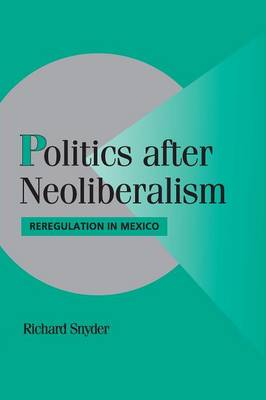
Politics after Neoliberalism :Reregulation in Mexico - Cambridge Studies in Comparative Politics
paperback
Published:
22 May, 2006

Popular Books by Richard Snyder
View All Books by Richard Snyder


Description
More Details
| Type | Book |
|---|---|
| ISBN13 | 9780521688703 |
| ISBN10 | 0521688701 |
| Number Of Pages | 274 |
| Item Weight | 370 g |
| Product Dimensions | 152 x 229 x 15 mm |
| Publisher / Reseller | Cambridge University Press |
| Format | paperback |
Media Reviews
"Numerous studies have been conducted on the consequences of the economic deregulation, but ew possess the analytical clarity, methodological rigor, and theoretical sophistication of Richard Synder's Politics after Neoliberalism. American Journal of Sociology
"This is a useful account of subnational political economy that also provides insight into the PRI's varied responses to diverse cross-pressures during the 1980's and the 1990's. Recommended for advaced undergraduates and above." Choice
"This is an important book that deserves to be read by students of comparative political economy and Latin American and Mexican politics." American Political Science Review
"...theoretically and empirically interesting and important." Political Science Quarterly
"As a whole, this book is a model of how to do comparative politics.... The empirical complexity and the highly nuanced nature of his main argument form an inspiring departure from over-simplified, one-dimensional analyses. Consequently, his study answers many questions but asks many more, some of which the author himself discusses in the final chapter. That is a mark of first-rate scholarship. Politics After Neoliberalism will rapidly become a classic in the comparative political economy literature, a work that will be required reading for graduate students and scholars interested in the politics of post-neoliberalism, the developing world, and the subnational comparative method." Latin American Politics and Society
"The subnational comparative case-study approach used by Richard Snyder in Politics after Neoliberalism is perhaps the best example of this kind of work currently available." Latin American Research Review
Author's Bio
Richard Snyder is Associate Professor of Political Science at Brown University. He previously taught at the University of Illinois, Urbana-Champaign. He has been a visiting fellow at the Harvard Academy for International and Area Studies and at the Center for US-Mexican Studies at the University of California, San Diego. His research has been supported by numerous institutions, including the National Science Foundation, the Institute of International Education, and the Institute for the Study of World Politics. He is the editor of three volumes on the political economy of rural Mexico, including Institutional Adaptation and Innovation in Rural Mexico. His articles have appeared in such journals as World Politics, Comparative Politics, Studies in Comparative International Development, and the British Journal of Political Science.