Low-Speed Aerodynamics - Cambridge Aerospace Series
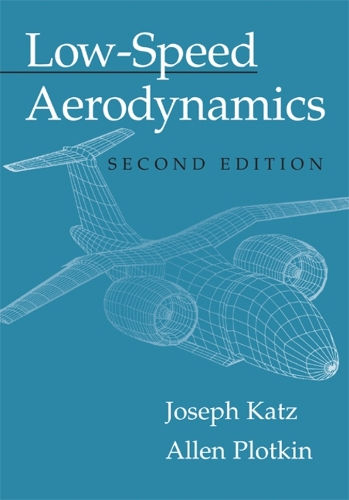
Low-Speed Aerodynamics - Cambridge Aerospace Series
paperback
Published:
5 February, 2001
paperback
Published:
5 February, 2001

Standard worldwide delivery by
Tue, June 23 - Thu, July 2
Order within
0
Popular Books by Joseph Katz
View All Books by Joseph Katz



Description
Low-speed aerodynamics is important in the design and operation of aircraft flying at low Mach number, and ground and marine vehicles. This 2001 book offers a modern treatment of the subject, both the theory of inviscid, incompressible, and irrotational aerodynamics and the computational techniques now available to solve complex problems. A unique feature of the text is that the computational approach (from a single vortex element to a three-dimensional panel formulation) is interwoven throughout. Thus, the reader can learn about classical methods of the past, while also learning how to use numerical methods to solve real-world aerodynamic problems. This second edition has a new chapter on the laminar boundary layer (emphasis on the viscous-inviscid coupling), the latest versions of computational techniques, and additional coverage of interaction problems. It includes a systematic treatment of two-dimensional panel methods and a detailed presentation of computational techniques for three-dimensional and unsteady flows. With extensive illustrations and examples, this book will be useful for senior and beginning graduate-level courses, as well as a helpful reference tool for practising engineers.
More Details
| Type | Book |
|---|---|
| ISBN13 | 9780521665520 |
| ISBN10 | 0521665523 |
| Number Of Pages | 630 |
| Item Weight | 1100 g |
| Product Dimensions | 181 x 253 x 33 mm |
| Publisher / Reseller | Cambridge University Press |
| Format | paperback |
| Edition | 2nd Revised edition |
See More +
Media Reviews
'This is a thoroughly modern and up-to-date high level academic textbook on theoretical low-speed aerodynamics, aimed at the advanced undergraduate or Masters level … Highly recommended.' Dr J. F. Henderson, Aeronautical Journal
'A superb, helpful reference.' Current Engineering Practice
'… a significant contribution to the aerodynamic literature. Several of my students have been able to begin their research careers in aerodynamics by reading and digesting this book. It is certainly a significant contribution to modern aerodynamic theory and numerical computation of aerodynamics flows over both simple 2-D and complex 3-D shapes.' Journal of Fluids Engineering