Industrializing English Law :Entrepreneurship and Business Organization, 1720–1844 - Political Economy of Institutions and Decisions
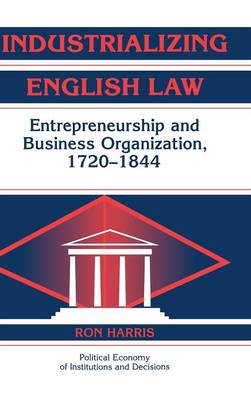
Industrializing English Law :Entrepreneurship and Business Organization, 1720–1844 - Political Economy of Institutions and Decisions
hardback
Published:
19 June, 2000

Popular Books by Ron Harris
View All Books by Ron Harris





Description
More Details
| Type | Book |
|---|---|
| ISBN13 | 9780521662758 |
| ISBN10 | 0521662753 |
| Number Of Pages | 350 |
| Item Weight | 750 g |
| Product Dimensions | 153 x 230 x 28 mm |
| Publisher / Reseller | Cambridge University Press |
| Format | hardback |
Media Reviews
Review of the hardback: 'Ron Harris' Industrializing English Law is an important addition to the literature on business organisation during early industrial capitalism which can lay genuine claim to being the most significant contribution to the field since those made by Hunt and duBois over sixty years ago.' Modern Law Review
Review of the hardback: '… exciting to read as well as a good source of reference. In the context of recent events such as the adoption of limited liability partnerships and the collapse of Enron, the book also provides a reminder that the legal framework within which commercial ventures take place is likely to remain under constant re-evaluation.' Cambridge Law Journal
Review of the hardback: 'This book deserves a wide readership: Ron Harris's study of the history of forms of business organisation from the early modern period down to 1844 and the emergence of the registered company form has important things to say to several constituencies … The fundamental merit of this book is that it shows in concrete detail that it is possible to discuss the historical relationships of law and the economy, using both economic and legal-historical methodology, without falling into the traps of a severely functionalist approach to law on the one hand, or a purely doctrinalist micro-narrative on the other. Harris has produced an extremely important book, and scholars in several fields of legal study will need to come to terms with his arguments.' Legal Studies