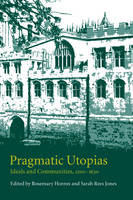
Pragmatic Utopias :Ideals and Communities, 1200–1630
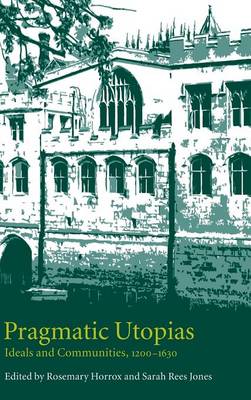
Pragmatic Utopias :Ideals and Communities, 1200–1630
hardback
Published:
29 November, 2001
hardback
Published:
29 November, 2001

Standard worldwide delivery by
Tue, July 7 - Fri, July 10
Order within
0
Popular Books by Rosemary Horrox
View All Books by Rosemary Horrox
Description
This collection of essays was presented to Barrie Dobson in celebration of his 70th birthday. It will be welcomed by all scholars of pre-modern religion and society. Spanning the artificial divide between medieval and early modern, the contributors - all acknowledged experts in their field - pursue the ways in which men and women tried to put their ideals into practice, sometimes alone, but more commonly in the shared environment of cloister, college or city. The range of topics is testimony to the breadth of Barrie Dobson's own interests, but even more striking are the continuities and shared assumptions across time, and between the dissident and the impeccably orthodox. Taking the reader from a rural anchor-hold to the London of Thomas More, and from the greenwood of Robin Hood to the central law courts, this collection builds into a richly satisfying exploration of the search for perfection in an imperfect world.
More Details
| Type | Book |
|---|---|
| ISBN13 | 9780521650601 |
| ISBN10 | 0521650607 |
| Number Of Pages | 298 |
| Item Weight | 610 g |
| Product Dimensions | 152 x 229 x 21 mm |
| Publisher / Reseller | Cambridge University Press |
| Format | hardback |
See More +
Media Reviews
Review of the hardback: '… an entree to a perhaps unfamiliar but certainly a fascinating world.' Utopian Studies
Review of the hardback: '… all these quality papers contain lessons, direct or implied, for historians of southern England.' Southern History Society
Review of the hardback: 'These essays are of a high standard, and carry many important insights.' History
Review of the hardback: 'the range of themes on important subjects, and the quality of the contributions, make this book especially welcome. It also serves as a fitting tribute to Professor Dobson's distinguished career.' The Ricardian