Developmental Regulation in Adulthood :Age-Normative and Sociostructural Constraints as Adaptive Challenges
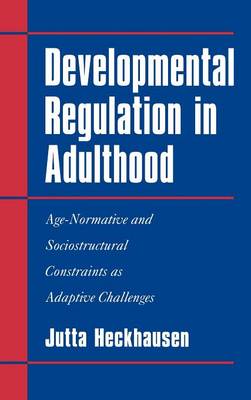
Developmental Regulation in Adulthood :Age-Normative and Sociostructural Constraints as Adaptive Challenges
hardback
Published:
28 November, 1998

Popular Books by Jutta Heckhausen
View All Books by Jutta Heckhausen





Description
More Details
| Type | Book |
|---|---|
| ISBN13 | 9780521581448 |
| ISBN10 | 0521581443 |
| Number Of Pages | 264 |
| Item Weight | 560 g |
| Product Dimensions | 152 x 229 x 19 mm |
| Publisher / Reseller | Cambridge University Press |
| Format | hardback |
Media Reviews
"Heckhausen's book is a highly significant event in the publication of life span developmental psychology theory and research. It is a persuasive and illuminating presentation of the ontogenic import of human plasticity and of the significant implications for theory and application of knowledge of adaptive human actions across life." Richard M. Lerner, Contemporary Psychology
Author's Bio
Jutta Heckhausen grew up in Germany and did her graduate work and Ph.D. at the University of Strathclyde in Glasgow, Scotland where she studied the way in which infants' development is promoted by interaction and joint activities with their mothers. In 1984, Dr Heckhausen joined the Center for Life-Span Psychology at the Max-Planck-Institute for Human Development in Berlin, where she became a senior scientist with her own research group. In the 1980s and 90s, she expanded her research area to include development in adulthood and old age, formulated the life-span theory of control with her collaborator Dr Richard Schulz, and launched a research program to test its propositions and applicability to developmental regulation in adulthood. In 1995–6, she was a fellow at the Center for Social and Behavioral Science at Stanford. In 2000, Dr Heckhausen joined the Department of Psychology and Social Behavior at UC Irvine and constituted the research laboratory on Life-Span Development and Motivation. Her current research focuses on motivation and agency in life-span development, particularly during developmental transitions.