Judicial Review in New Democracies :Constitutional Courts in Asian Cases
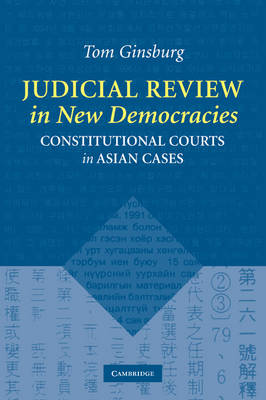
Judicial Review in New Democracies :Constitutional Courts in Asian Cases
paperback
Published:
23 July, 2003
paperback
Published:
23 July, 2003

Standard worldwide delivery by
Tue, July 21 - Thu, July 30
Order within
0
Popular Books by Tom Ginsburg
View All Books by Tom Ginsburg


Description
New democracies around the world have adopted constitutional courts to oversee the operation of democratic politics. Where does judicial power come from, how does it develop in the early stages of democratic liberalization, and what political conditions support its expansion? This book answers these questions through an examination of three constitutional courts in Asia: Taiwan, Korea, and Mongolia. In a region that has traditionally viewed law as a tool of authoritarian rulers, constitutional courts in these three societies are becoming a real constraint on government. In contrast with conventional culturalist accounts, this book argues that the design and functioning of constitutional review are largely a function of politics and interests. Judicial review - the power of judges to rule an act of a legislature or national leader unconstitutional - is a solution to the problem of uncertainty in constitutional design. By providing 'insurance' to prospective electoral losers, judicial review can facilitate democracy.
More Details
| Type | Book |
|---|---|
| ISBN13 | 9780521520393 |
| ISBN10 | 0521520398 |
| Number Of Pages | 312 |
| Item Weight | 426 g |
| Product Dimensions | 152 x 228 x 23 mm |
| Publisher / Reseller | Cambridge University Press |
| Format | paperback |
See More +
Media Reviews
"Every serious scholar and student of constitutional politics and institutional design should read this book." The Law and Politics Book Review
"Ginsburg provides compelling empirical support in his three East Asian cases that judicial power increases when political power is diffuse. Because he is interested in highlihgting the conditions under which courts can constrain other political actors, compliance is an important indicator of judicial independence." - Shannon Roesler, Law and Social Inquiry