Democratic Subjects :The Self and the Social in Nineteenth-Century England
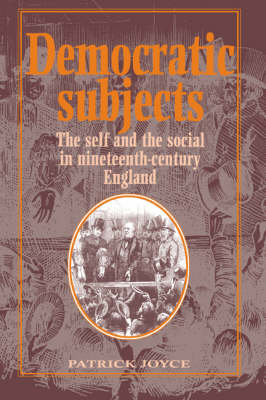
Democratic Subjects :The Self and the Social in Nineteenth-Century England
paperback
Published:
6 October, 1994

Popular Books by Patrick Joyce
View All Books by Patrick Joyce


Description
More Details
| Type | Book |
|---|---|
| ISBN13 | 9780521448024 |
| ISBN10 | 0521448026 |
| Number Of Pages | 260 |
| Item Weight | 376 g |
| Product Dimensions | 152 x 229 x 15 mm |
| Publisher / Reseller | Cambridge University Press |
| Format | paperback |
Media Reviews
"Joyce's investigation of the lives, careers, and ideas of Waugh, Bright, and other "demotic" figures, as well as his more general analysis of the "democratic romances" expressed in melodramas, popular fiction, journalism, and other discursive forms, are detailed, thoroughly researched, and usually astute about the social contradictions informing "the democratic imaginary" of past and present." Nineteenth-Century Prose
"This is a skillfully constructed book, with the divergent but intertwined histories of Waugh and Bright, and the narratives which they created and sustained, now converging, now separating, but always illuminating the central argument....As a conventional intellectual biography, Joyce's study of Waugh is exemplary and highly illuminating; as an application of the ideas of the 'linguistic turn' to mid-Victorian politics, his study of Bright produces equally rich insights; and as an interdisciplinary discussion of the force of political and social narratives, the essay on democratic romances opens up vistas likely to be the focus of considerable future work both by Joyce and his students." Martin Hewitt, Victorian Review
"...an intriguing, at times dense, etymological critique of the nature of democracy and social identity...." R.A. Soloway, Choice
"...a confident presentation..." David Mayfield, Albion