Quantum Measurement
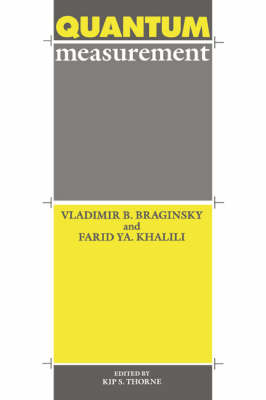
Quantum Measurement
hardback
Published:
24 September, 1992
hardback
Published:
24 September, 1992

Standard worldwide delivery by
Tue, September 1 - Fri, September 4
Order within
0
Popular Books by Kip S. Thorne
View All Books by Kip S. Thorne
Description
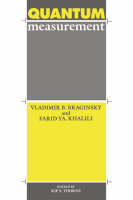
This book is an up-to-date introduction to the quantum theory of measurement, a fast developing field of intense current interest to scientists and engineers for its potential high technology applications. It is also a subject of importance to students for its central role in the foundations of quantum mechanics. Although the main principles of the field were elaborated in the 1930s by Bohr, Schrödinger, Heisenberg, von Neumann and Mandelstam, it was not until the 1980s that technology became sufficiently advanced to allow its application in real experiments. Quantum measurement is now central to many ultra-high technology developments, such as squeezed light, single atom traps, and searches for gravitational radiation. It is also considered to have great promise for computer science and engineering, particularly for its applications in information processing and transfer. The book contains a pedagogical introduction to the relevant theory written at a level accessible to those with only a modest background in quantum mechanics. It then goes on to discuss aspects of the design of practical quantum measurement systems. This book is essential reading for all scientists and engineers interested in the potential applications of technology near the quantum limit. It will also serve as an ideal supplement to standard quantum mechanics textbooks at the advanced undergraduate or graduate level.
More Details
| Type | Book |
|---|---|
| ISBN13 | 9780521419284 |
| ISBN10 | 052141928X |
| Number Of Pages | 212 |
| Item Weight | 432 g |
| Product Dimensions | 156 x 236 x 16 mm |
| Publisher / Reseller | Cambridge University Press |
| Format | hardback |
See More +
Media Reviews
' … applies all tools of classical and quantum measurement to the measurement of small forces. The tools include evolution operators, eigenstates, density matrices, correlation functions, noise spectral densities and hetero- and homodyne detection … the ideas, all subtle, fundamental and useful, are the original work of the authors … will provide easy-to-understand examples for the quantum mechanics texts of the future, and it will influence the direction of research in quantum mechanics.' Donald Searl, Physics Today