The Body in History :Europe from the Palaeolithic to the Future
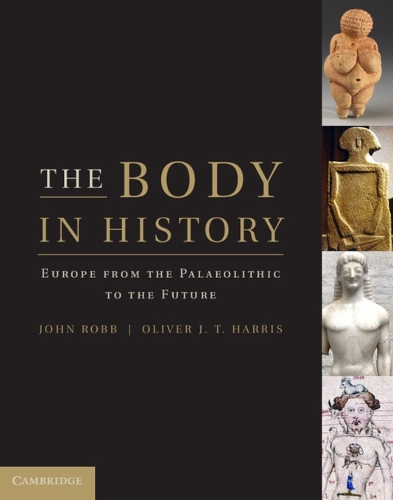
The Body in History :Europe from the Palaeolithic to the Future
paperback
Published:
12 November, 2015

Popular Books by John Robb
View All Books by John Robb



Description
Prizes
Winner of PROSE Award for Excellence in the Social Sciences 2013,Winner of PROSE Award for Archaeology and Anthropology 2013
More Details
| Type | Book |
|---|---|
| ISBN13 | 9780521124119 |
| ISBN10 | 0521124115 |
| Number Of Pages | 300 |
| Item Weight | 850 g |
| Product Dimensions | 216 x 281 x 15 mm |
| Publisher / Reseller | Cambridge University Press |
| Format | paperback |
Media Reviews
'This book is amazing. Robb and Harris take us on a grand tour of the human body, tracing its diverse forms and attachments over a span of 50,000 years. Rarely do so many fascinating ideas come together in one place. For scholars who study the body in Africa, Asia, or the New World, the book offers a steady stream of comparative insights. As an experiment in multiscalar analysis, The Body in History is a tantalizing, indispensable model for future work.' Andrew Shryock, University of Michigan
'An encyclopedic collection of articles that addresses the crucial question of how and why bodily understandings and practices change throughout history. Wide-ranging and creative in its sources, and innovative theoretically and methodologically, The Body in History is an invaluable contribution to, and will be required reading for anyone interested in, the field of body studies.' Chris Shilling, author of The Body and Social Theory
'A masterful book that brings multidisciplinary analysis to bear on the question of the social body. The focus on diachronic change – on transition and transformation – as well as on scales of practice, makes this an original and much-needed contribution that will be of interest not only to historians and archaeologists but also to scholars from diverse fields that engage with study of the body. This text is a must-read that will be used in both teaching and research.' Barbara L. Voss, Stanford University, California
'This remarkable volume demonstrates how the idea of the body has been dramatically reworked in successive eras, from the Pleistocene to the present day. Spanning archaeology, history, and cultural studies, the chapters argue that, more than a concept, the body is simultaneously a collection of gestures and comportments that can vary from one era to the next. In a world transfixed by the prospects for robotic and bionic engineering, where the body/technology boundary is becoming increasingly porous and zombies are everywhere, this beautifully written study demonstrates how the body itself has always been in history.' Daniel Lord Smail, Harvard University, Massachusetts
GoodReads Reviews
Author's Bio
John Robb is Reader in European Prehistory at the University of Cambridge. He has worked extensively in Central Mediterranean prehistory and archaeological theory and human skeletal studies, and is the author of The Early Mediterranean Village (Cambridge, 2007). He edits the Cambridge Archaeological Journal and is currently researching prehistoric art in Europe. Oliver J. T. Harris is Lecturer in Archaeology at the University of Leicester. He is the co-director of the Ardnamurchan Transitions Project, which examines the long-term occupation of the Ardnamurchan peninsula in western Scotland and excavates sites from all periods including Neolithic, Bronze Age, Iron Age, Viking and post-Medieval. He has published on Neolithic Britain and archaeological theory in a range of journals including Archaeological Dialogues, World Archaeology and the European Journal of Archaeology. He is currently writing a book on the archaeology of communities.