Ends of Complexes - Cambridge Tracts in Mathematics
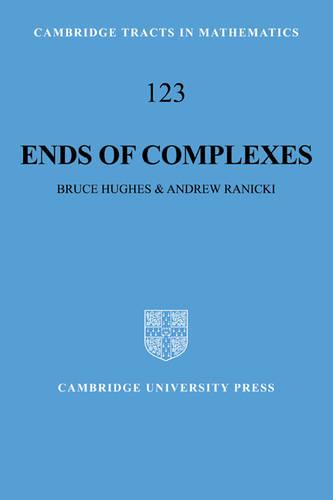
Ends of Complexes - Cambridge Tracts in Mathematics
paperback
Published:
21 January, 2008
paperback
Published:
21 January, 2008

Standard worldwide delivery by
Tue, July 14 - Thu, July 23
Order within
0
Popular Books by Bruce Hughes
View All Books by Bruce Hughes
Description
The ends of a topological space are the directions in which it becomes non-compact by tending to infinity. The tame ends of manifolds are particularly interesting, both for their own sake, and for their use in the classification of high-dimensional compact manifolds. The book is devoted to the related theory and practice of ends, dealing with manifolds and CW complexes in topology and chain complexes in algebra. The first part develops a homotopy model of the behaviour at infinity of a non-compact space. The second part studies tame ends in topology. Tame ends are shown to have a uniform structure, with a periodic shift map. Approximate fibrations are used to prove that tame manifold ends are the infinite cyclic covers of compact manifolds. The third part translates these topological considerations into an appropriate algebraic context, relating tameness to homological properties and algebraic K- and L-theory.
More Details
| Type | Book |
|---|---|
| ISBN13 | 9780521055192 |
| ISBN10 | 0521055199 |
| Number Of Pages | 380 |
| Item Weight | 576 g |
| Product Dimensions | 151 x 228 x 21 mm |
| Publisher / Reseller | Cambridge University Press |
| Format | paperback |
See More +
Media Reviews
'The book gathers together the main strands of the theory of ends of manifolds from the last thirty years and presents a unified and coherent treatment of them. It also contains authoritative expositions of certain topics in topology such as mapping tori and telescopes, often omitted from textbooks. It is thus simultaneously a research monograph and a useful reference.' Proceedings of the Edinburgh Mathematical Society
'This is a highly specialized monograph which is very clearly written and made as accessible for the reader as possible … It is absolutely indispensable for any specialist in the field.' European Mathematical Society