Discrete Mathematics with Applications, International Edition
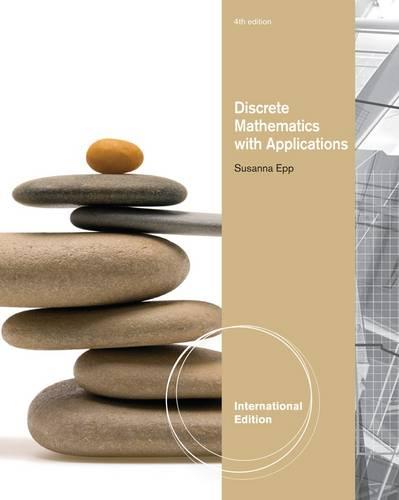
Discrete Mathematics with Applications, International Edition
paperback
Published:
27 May, 2011

Popular Books by Susanna Epp
View All Books by Susanna Epp
Description
More Details
| Type | Book |
|---|---|
| ISBN13 | 9780495826163 |
| ISBN10 | 0495826162 |
| Number Of Pages | 984 |
| Item Weight | 1610 g |
| Product Dimensions | 78 x 17 x 99 mm |
| Publisher / Reseller | Cengage Learning, Inc |
| Format | paperback |
| Edition | 4th edition |
Media Reviews
1. SPEAKING MATHEMATICALLY. Variables. The Language of Sets. The Language of Relations and Functions. 2. THE LOGIC OF COMPOUND STATEMENTS. Logical Form and Logical Equivalence. Conditional Statements. Valid and Invalid Arguments. Application: Digital Logic Circuits. Application: Number Systems and Circuits for Addition. 3. THE LOGIC OF QUANTIFIED STATEMENTS. Predicates and Quantified Statements I. Predicates and Quantified Statements II. Statements with Multiple Quantifiers. Arguments with Quantified Statements. 4. ELEMENTARY NUMBER THEORY AND METHODS OF PROOF. Direct Proof and Counterexample I: Introduction. Direct Proof and Counterexample II: Rational Numbers. Direct Proof and Counterexample III: Divisibility. Direct Proof and Counterexample IV: Division into Cases and the Quotient-Remainder Theorem. Direct Proof and Counterexample V: Floor and Ceiling. Indirect Argument: Contradiction and Contraposition. Indirect Argument: Two Classical Theorems. Application: Algorithms. 5. SEQUENCES, MATHEMATICAL INDUCTION, AND RECURSION. Sequences. Mathematical Induction I. Mathematical Induction II. Strong Mathematical Induction and the Well-Ordering Principle. Application: Correctness of Algorithms. Defining Sequences Recursively. Solving Recurrence Relations by Iteration. Second-Order Linear Homogeneous Recurrence Relations with Constant Coefficients. General Recursive Definitions and Structural Induction. 6. SET THEORY. Set Theory: Definitions and the Element Method of Proof. Set Identities. Disproofs and Algebraic Proofs. Boolean Algebras, Russell's Paradox, and the Halting Problem. 7. PROPERTIES OF FUNCTIONS. Functions Defined on General Sets. One-to-one, Onto, Inverse Functions. Composition of Functions. Cardinality, Sizes of Infinity, and Applications to Computability. 8. PROPERTIES OF RELATIONS. Relations on Sets (add material about relational databases). Reflexivity, Symmetry, and Transitivity. Equivalence Relations. Modular Arithmetic with Applications to Cryptography. Partial Order Relations. 9. COUNTING. Counting and Probability. The Multiplication Rule. Counting Elements of Disjoint Sets: The Addition Rule. The Pigeonhole Principle. Counting Subsets of a Set: Combinations. r-Combinations with Repetition Allowed. Pascal's Formula and the Binomial Theorem. Probability Axioms and Expected Value. Conditional Probability, Bayes' Formula, and Independent Events. 10. GRAPHS AND TREES. Graphs: An Introduction. Trails, Paths, and Circuits. Matrix Representations of Graphs. Isomorphisms of Graphs. Trees: Examples and Basic Properties. Rooted Trees. Spanning Trees and a Shortest Path Algorithm. 11. ANALYZING ALGORITHM EFFICIENCY. Real-Valued Functions of a Real Variable and -Notations. Application: Efficiency of Algorithms I.?-, and ?Their Graphs. O-, Exponential and Logarithmic Functions: Graphs and Orders. Application: Efficiency of Algorithms II. 12. REGULAR EXPRESSIONS AND FINITE STATE AUTOMATA. Formal Languages and Regular Expressions. Finite-State Automata. Simplifying Finite-State Automata.
Author's Bio
Susanna S. Epp received her Ph.D. in 1968 from the University of Chicago, taught briefly at Boston University and the University of Illinois at Chicago, and is currently Vincent DePaul Professor Emerita of Mathematical Sciences at DePaul University. After initial research in commutative algebra, she became interested in cognitive issues associated with teaching analytical thinking and proof and published a number of articles related to this topic, one of which was chosen for inclusion in The Best Writing on Mathematics 2012. She has spoken widely on discrete mathematics and organized sessions at national meetings on discrete mathematics instruction. In addition to Discrete Mathematics with Applications and Discrete Mathematics: An Introduction to Mathematical Reasoning, she is co-author of Precalculus and Discrete Mathematics, which was developed as part of the University of Chicago School Mathematics Project. The third edition of Discrete Mathematics with Applications received a Texty Award for Textbook Excellence in June 2005. Epp co-organized an international symposium on teaching logical reasoning, sponsored by the Institute for Discrete Mathematics and Theoretical Computer Science (DIMACS), and she was an associate editor of Mathematics Magazine from 1991 to 2001. Long active in the Mathematical Association of America (MAA), she is a co-author of the curricular guidelines for undergraduate mathematics programs: CUPM Curriculum Guide 2004. She received the Hay Award for Contributions to Mathematics Education in 2005 and the Award for Distinguished Teaching given by the Illinois Section of the MAA in 2010.