Thermodynamics
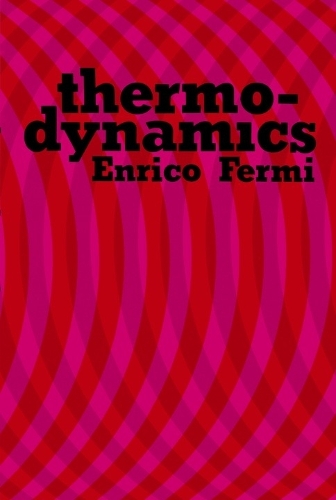
Thermodynamics
paperback
Published:
1 February, 2000

Popular Books by Enrico Fermi
View All Books by Enrico Fermi
Description
More Details
| Type | Book |
|---|---|
| ISBN13 | 9780486603612 |
| ISBN10 | 048660361X |
| Number Of Pages | 176 |
| Item Weight | 221 g |
| Product Dimensions | 137 x 202 x 8 mm |
| Publisher / Reseller | Dover Publications Inc. |
| Format | paperback |
Author's Bio
Enrico Fermi: Father of the Atomic Age
Enrico Fermi (19011954) received the 1938 Nobel Prize in Physics "for his demonstrations of new radioactive elements produced by neutron irradiation, and for his related discovery of nuclear reactions brought about by slow neutrons." Just a year before winning the Nobel Prize, Fermi published Thermodynamics, based on a course of lectures at Columbia University, an enduring work which Dover first reprinted in 1956 and which has been in print continuously since then, one of the foundations of Dover's physics program.
Both a theorist and an experimentalist, Fermi packed an immense amount of science into his relatively short life, which ended prematurely as a consequence of the radiation he received working on the development of the atomic bomb. His work, of course, was not just in the realm of nuclear physics: Fermi will always be the most remembered for the events of December 2, 1942, when he and other scientists at the University of Chicago's Stagg Field produced the world's "first self-sustaining chain reaction . . . instituting the controlled release of atomic energy."
In the Author's Own Words:
"There are two possible outcomes: If the result confirms the hypothesis, then you've made a measurement. If the result is contrary to the hypothesis, then you've made a discovery." Enrico Fermi
Critical Acclaim for Enrico Fermi:
"He was simply unable to let things be foggy. Since they always are, this kept him pretty active." J. Robert Oppenheimer