Recent Trends in Fractional Calculus and Its Applications - Advanced Studies in Complex Systems
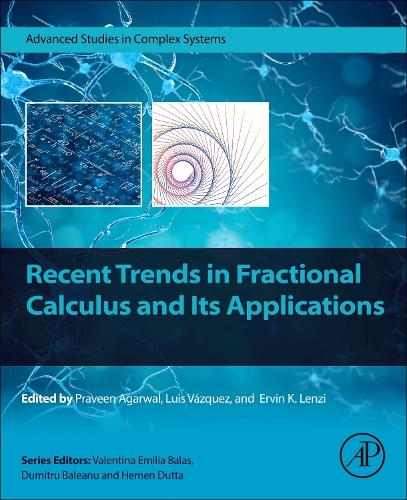
Recent Trends in Fractional Calculus and Its Applications - Advanced Studies in Complex Systems
paperback
Published:
8 July, 2024

Popular Books by Praveen Agarwal
View All Books by Praveen Agarwal
Description
More Details
| Type | Book |
|---|---|
| ISBN13 | 9780443185052 |
| ISBN10 | 0443185050 |
| Number Of Pages | 300 |
| Item Weight | 640 g |
| Publisher / Reseller | Elsevier Science Publishing Co Inc |
| Format | paperback |
Author's Bio
Dr. Praveen Agarwal is Vice-Principal and Professor at Anand International College of Engineering, Jaipur, India. He is listed as the World's Top 2% Scientist in 2020, 2021, 2022, and 2023, released by Stanford University. In the 2023 ranking of best scientists worldwide announced by Research.com, he ranked 21st at the India level and 2436th worldwide in Mathematics. He is a Managing Editor of Book seriesMathematics for Sustainable Developments, Springer Nature,and Editor ofBook series Mathematical Modelling & Computational Method for Innovation, Taylor & Francis Group. He published more than 350 papers in international reputed Journals. Dr. Luis Vázquez Martínez is Professor Emeritus of Applied Mathematics Departamento de Matématica Aplicada, Faculdad do Informática, Universidad Complutense de Madrid, Spain. Dr. Martínez has held many distinguished administrative positions throughout his career, including Vice-Dean of Research, External Relations and Students of Facultad de Ciencias Físicas, Academic Director of Research at UCM, and Director and Founder of the European Office of Research and the Supercomputing Center, UCM, among many others. Dr. Martínez has received many awards and research honors during his distinguished career, including the Daza Valdés Prize from the Spanish Society of Optica, Cavaliere dell’Ordine della Stella from the Republic of Italy, NASA Distinction as Principal Investigator of REMS-Curiosity-MSL, and the Liouville Award for Lifetime Achievements in the Area of Fractional Calculus and Its Applications. Dr. Martínez was a Founding Member of the Centre of Astrobiology associated with NASA in its Mars exploration program, where he founded and managed the Advanced Computer Laboratory. Dr. Ervin K. Lenzi is Associate Professor of Physics at Universidade Estaudal de Ponta Grossa, Brazil. Dr. Lenzi has a Ph.D. in Physics from Centro Brasileiro de Pesquisas Física, and was a Postdoc Fellow in Physics at Politecnico di Torino, Italy. His research interests include Diffusive Processes, Complex Systems, and Applications of the Diffusion Equation. Dr. Lenzi is on the Editorial Board of Journal of Geophysics and Engineering, Mathematical Problems in Engineering, and Quantum Reports.