Language Rights - Critical Concepts in Language Studies
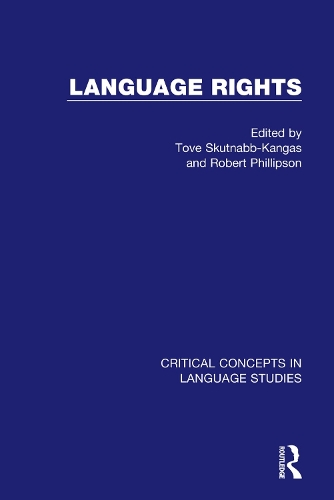
Language Rights - Critical Concepts in Language Studies
other
Published:
26 October, 2016

Popular Books by Tove Skutnabb-Kangas
View All Books by Tove Skutnabb-Kangas
Description
Research on Language Rights has produced an enormous—and unwieldy—corpus of literature. Such work often has limitations because scholars from different disciplinary traditions have seldom coordinated their concerns or integrated the conceptual traditions of particular fields. To enable researchers and advanced students to make sense of this vast literature, and the disparate scholarly approaches, Routledge announces Language Rights, a new title in its Critical Concepts in Language Studies series. In four volumes, the set draws on a wide range of disciplines, including language policy, political theory, education, law, philosophy, anthropology, economics, minority studies, deaf studies, and Indigenous cosmologies. The editors have assembled both normative texts and studies of their practical applications over the past century in a wide range of countries, as well as more diverse interventions and interpretations.
Volume I (‘Language Rights, Past and Present: From Minority Rights to Linguistic Human Rights’) presents some of the basic concepts in language rights and traces developments from treaties and national constitutions to human rights principles, and conditions for the maintenance of languages.
Volume II (‘Multilingualism, Education, and Language Rights Granted or Denied: Policies and Politics’) explores the tensions between homogenizing nation states and the status of indigenous and minority languages in education.
Volume III in the collection (‘Language Rights and Endangered Languages’) brings together the best thinking on recent developments in language and cultural revitalization through community mobilization around language rights, especially in education, the preconditions for their success, their relationship to land rights and self-determination, and state responses to demands for language rights. Finally, Volume IV (‘Language Rights: Global and Regional Integration and Diversity Maintenance’) assesses ongoing trends of regional and global integration and questions the prospects for the world’s languages in the light of economic and cultural constraints, and the weaknesses of the international human rights system.
With newly written, comprehensive introductions to each volume, and to the collection as a whole, Language Rights is destined to be welcomed as a vital research and pedagogic resource.
More Details
| Type | Book |
|---|---|
| ISBN13 | 9780415740821 |
| ISBN10 | 0415740827 |
| Number Of Pages | 1736 |
| Item Weight | 3400 g |
| Publisher / Reseller | Taylor & Francis Ltd |
| Format | other |
Media Reviews
"The right to speak your own language seems as obvious as breathing air; nonetheless every day on all continents people are denied this basic right. These state of the art volumes on language rights are a valuable resource for researchers and practitioners worldwide. The multidisciplinary approach provides the nuanced insight needed for understanding the complex world of language rights. It is the key tool for addressing the concrete challenges."
Professor Morten Kjærum is the Director of the Raoul Wallenberg Institute of Human Rights and Humanitarian Law in Lund, Sweden. From 2008 to 2015 he was the Director of the European Union Agency for Fundamental Rights in Vienna, prior to which he was the director of the Danish Institute of Human Rights in Copenhagen, and a member of UN Committees on the Elimination of Racial Discrimination.
"An historic emancipation is underway, revolving around language, cultural difference, and ethnic affiliation. Central to activating the human right to difference is the formative and irreducible importance of language. This is not to imply that individuals are imprisoned cognitively in languages, but to recognise that our languages are deeply significant for our personal and social lives, and that much injustice in the world continues to be perpetrated against individuals and entire communities on the basis of their forms of communication. The emancipation process is actively denied in large parts of the world. These four volumes are the deepest and widest approach to language rights yet produced, and help us both understand and advance communication rights and their cultural and political consequences. By directing our attention to the vast enterprise of practice and reflection invested in specifying and advancing language rights, these volumes are the indispensable collection for the field. I warmly welcome it and commend its contributors and especially its very dedicated editors."
Joseph Lo Bianco is Professor of Language and Literacy Education at the Melbourne Graduate School of Education. He wrote Australia’s National Policy on Languages in 1987, and has advised governments worldwide on language policy. He is currently working in several Asian countries with education and language policies for peace-building.
Author's Bio
Tove Skutnabb-Kangas, Åbo Akademi University, Finland.
Tove Skutnabb-Kangas has written or edited over 50 books and over 400 articles published in 48 languages on minority education, multilingualism, linguistic human rights, linguistic genocide, ecolinguistics, and the subtractive spread of English. She was awarded the UNESCO Linguapax prize in 2003. http://www.tove-skutnabb-kangas.org.
Robert Phillipson, Copenhagen Business School, Denmark.
Robert Phillipson is a prolific scholar who has written or edited books on linguistic imperialism and the globalization of English, European Union language policy, language rights, and multilingualism in education. He was awarded the UNESCO Linguapax prize in 2010. http://www.cbs.dk/en/staff/rpibc.