US Covert Operations and Cold War Strategy :Truman, Secret Warfare and the CIA, 1945-53 - Studies in Intelligence
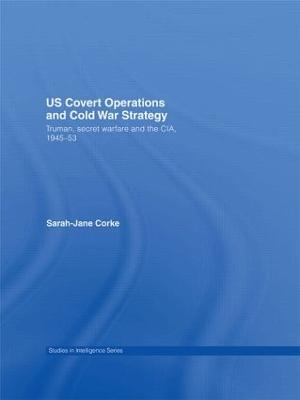
US Covert Operations and Cold War Strategy :Truman, Secret Warfare and the CIA, 1945-53 - Studies in Intelligence
hardback
Published:
6 September, 2007

Popular Books by Sarah-Jane Corke
View All Books by Sarah-Jane Corke
Description
Based on recently declassified documents, this book provides the first examination of the Truman Administration’s decision to employ covert operations in the Cold War.
Although covert operations were an integral part of America’s arsenal during the late 1940s and early 1950s, the majority of these operations were ill conceived, unrealistic and ultimately doomed to failure. In this volume, the author looks at three central questions: Why were these types of operations adopted? Why were they conducted in such a haphazard manner? And, why, once it became clear that they were not working, did the administration fail to abandon them?
The book argues that the Truman Administration was unable to reconcile policy, strategy and operations successfully, and to agree on a consistent course of action for waging the Cold War. This ensured that they wasted time and effort, money and manpower on covert operations designed to challenge Soviet hegemony, which had little or no real chance of success.
US Covert Operations and Cold War Strategy will be of great interest to students of US foreign policy, Cold War history, intelligence and international history in general.
More Details
| Type | Book |
|---|---|
| ISBN13 | 9780415420778 |
| ISBN10 | 0415420776 |
| Number Of Pages | 256 |
| Item Weight | 630 g |
| Publisher / Reseller | Taylor & Francis Ltd |
| Format | hardback |
Media Reviews
'It is clear that Corke has done a great job marshalling documentation from many different sources—her research in this incredibly murky area adds tremendously to our knowledge, illuminating how departments responsible for psychological warfare during the conflict were reorganized or eliminated ... [Corke] has prepared a very important book that all scholars of the early cold war era must consult—especially those that are interested in the intelligence bureaucracy where the literature is quite thin.' - Gregory Mitrovich, H-Diplo Roundtable Reviews, Vol. XI, No. 29 (2010), 14
'Corke's work makes a valuable contribution to our understanding of Cold War policymaking, adding insightful depth as well as breadth.' - Mark Montesclaros, H-Net.org, April, 2010
Author's Bio
Sarah-Jane Corke is Assistant Professor, Department of History, Dalhousie University, and has a PhD from the University of New Brunswick [2000].