Nation-States and Money :The Past, Present and Future of National Currencies - RIPE Series in Global Political Economy
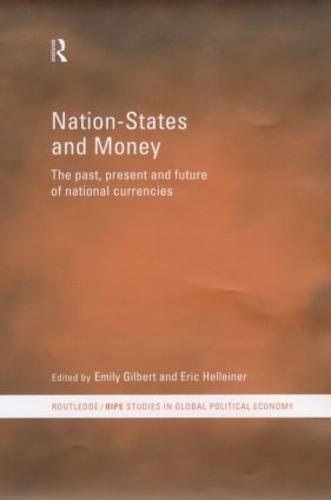
Nation-States and Money :The Past, Present and Future of National Currencies - RIPE Series in Global Political Economy
hardback
Published:
18 November, 1999
hardback
Published:
18 November, 1999

Standard worldwide delivery by
Wed, July 22 - Fri, July 31
Order within
0
Condition:
NEW
$178.14
RRP
$211.90
You save $33.76 (16%)
Available
5
in stock
FREE Returns within 30 days
Popular Books by Emily Gilbert
View All Books by Emily Gilbert


Description
National currencies appear to be threatened from all sides. European Union member countries are due to abandon their national currencies in favour of a supranational currency by the year 2000. Elsewhere, the use of foreign currencies within national economic spaces is on the increase, as shown by the growth of eurocurrency activity, and currency substitution in many parts of the world. In the last decade, privately-issued sub-national local currencies have also proliferated in a number of countries, and predict the emergence of private electronic monies of the future. In the light of these transformations, this book asks what the future holds for national currencies. The first half of the volume addresses issues relating to money leading up to, and during, the formation of national currencies. Ranging widely in their historical and geographical context, the papers problematise the relationship between money and nation-states by examining alternative forms and uses of currencies during this period. The second half look at contemporary challenges faced by national currencies.
More Details
| Type | Book |
|---|---|
| ISBN13 | 9780415189262 |
| ISBN10 | 0415189268 |
| Number Of Pages | 260 |
| Item Weight | 640 g |
| Publisher / Reseller | Taylor & Francis Ltd |
| Format | hardback |
See More +
Media Reviews
rB'This is an excellent book, which will long be seen as providing a defining statement on the links between money and nation-states. The editors have clearly paid much attention to the minutiae of putting the book together and should be congratulated' - Tim Unwin, University of London