Risk and Blame :Essays in Cultural Theory
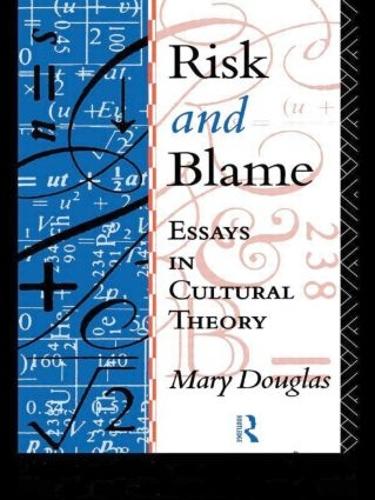
Risk and Blame :Essays in Cultural Theory
paperback
Published:
10 November, 1994

Popular Books by Professor Mary Douglas
View All Books by Professor Mary Douglas



Description
Risk and danger are culturally conditioned ideas. They are shaped by pressures of social life and accepted notions of accountability. The risk analyses that are increasingly being utilised by politicians, aid programmes and business ignore the insights to be gained from social anthropology which can be applied to modern industrial society.
In this collection of recent essays, Mary Douglas develops a programme for studying risk and blame that follows from ideas originally proposed in Purity and Danger. She suggests how political and cultural bias can be incorporated into the study of risk perception and in the discussion of responsibility in public policy.
More Details
| Type | Book |
|---|---|
| ISBN13 | 9780415119993 |
| ISBN10 | 0415119995 |
| Number Of Pages | 336 |
| Item Weight | 340 g |
| Publisher / Reseller | Taylor & Francis Ltd |
| Format | paperback |
Media Reviews
[an] always rewarding collection covering topics as diverse as witchcraft, the usefulness of stigma, the misguided search for the historical Jesus, and the contrasting cultures and consequent effectiveness of Swedish and English trade unions . . . For my money, Douglas's sure grasp of how symbolism is tied to social relations is indispensable in making sense of contemporary religious conflict.
- Commonweal
Characteristic of Douglas' other works, these essays define cultural theory as a way of thinking about culture that draws the social environment systematically into the picture of individual choices, a method of analyzing public debates as positions taken in a conflict between cultures (xi). This definition is of value for how it frames a theory of culture that guides research while compelling us to recognize the real subject of our interest..
... Douglas's arguments about the ideological bases of knowledge and consequently its necessary political implications are notonly eloquent but convincing. One can only admire the frankness with which she makes an (avowedly unpopular) case for hierarchy, and agree that those who appeal instead to abstract reason or justice are merely less forthright or less lucid.
- Zygon