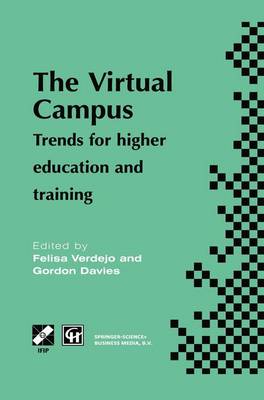
The Virtual Campus :Trends for higher education and training - IFIP Advances in Information and Communication Technology
The Virtual Campus :Trends for higher education and training - IFIP Advances in Information and Communication Technology
hardback
Published:
31 January, 1997
hardback
Published:
31 January, 1997

Standard worldwide delivery by
Fri, July 17 - Wed, July 22
Order within
0
Popular Books by Gordon Davies
View All Books by Gordon Davies







Description
The virtual campus: Trends for higher education and trainingwas the theme of the IFIP Working Conference on which this book is based. lt was a joint event of Working Groups 3.3 and 3.6, Research and distance Education respectively, of IFIP Technical Committee 3 for Education. International dissemination and promotion of cooperation are IFIP aims that we particularly wanted to address. This is why we opened the event to non WG members and have established a virtual forum on the WEB that has been widely visited. The programme for the 27 to 29 November 97 in Madrid included invited speakers from leading institutions in the field, reviewed and selected contributions from an open call for papers, on-site demonstrations of !arge European projects and discussion sessions involving distant and present participants. The event attracted experts from 23 countries. About a hundred persons were involved, from all over the world. The spread and accessibility of information and communication technologies are rapidly changing p!"actices in learning and research activities, both in professional and academic settings. The number, variety and scale of experiences reported in recent publications shows a growing international involvement concerning not only small groups of researchers but also institutions fully committed in that direction.
More Details
| Type | Book |
|---|---|
| ISBN13 | 9780412835506 |
| ISBN10 | 0412835509 |
| Number Of Pages | 308 |
| Item Weight | 1000 g |
| Publisher / Reseller | Chapman and Hall |
| Format | hardback |
| Edition | 1998 ed. |
See More +
Media Reviews
`This is an information-packed volume. The papers are timely and thought provoking and offer excellent lists of references. Overall, the book provides a perspective on networked learning and is a valuable and up-to-date resource for anyone in the field of distance education. The main topics are of primary concern to today's tele-educator: global approaches, evaluation studies, collaberative activities and web tools. Best of all, the book is international in theme and scope.'
M. Sock McIsaac, Computers & Education, 33:77-82 (1999)