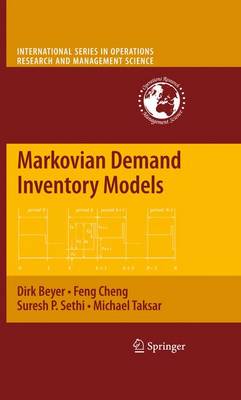
Markovian Demand Inventory Models - International Series in Operations Research & Management Science
Markovian Demand Inventory Models - International Series in Operations Research & Management Science
hardback
Published:
16 October, 2009

Popular Books by Suresh P. Sethi
View All Books by Suresh P. Sethi







Description
Inventory management is concerned with matching supply with demand and a central problem in Operations Management. The problem is to find the amount to be produced or purchased in order to maximize the total expected profit or minimize the total expected cost. Over the past two decades, several variations of the formula appeared, mostly in trade journals written by and for inventory managers. A critical assumption in the inventory literature is that the demands in different periods are independent and identically distributed. However, in real life, demands may depend on environmental considerations or the events in the world such as the weather, the state of economy, etc. Moreover, these events are represented by stochastic processes - exogenous or controlled.
In Markovian Demand Inventory Models, the authors are concerned with inventory models where these world events are modeled by Markov processes. Their research on Markovian demand inventory models was carried out over a period of ten years beginning in the early nineties.
More Details
| Type | Book |
|---|---|
| ISBN13 | 9780387716039 |
| ISBN10 | 0387716033 |
| Number Of Pages | 255 |
| Item Weight | 1000 g |
| Publisher / Reseller | Springer-Verlag New York Inc. |
| Format | hardback |
| Edition | 2010 ed. |
Media Reviews
From the reviews:
“In this book, the authors present a complete, rigorous mathematical treatment of the classical dynamic inventory models with stochastic demands. … This book is an elegant and comprehensive account of Markovian demand inventory models. It will be useful for students, researchers and practitioners in operations management and industrial engineering.” (P. R. Parthasarathy, Mathematical Reviews, Issue 2012 g)