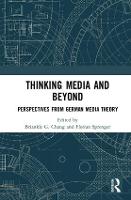
Thinking Media and Beyond :Perspectives from German Media Theory
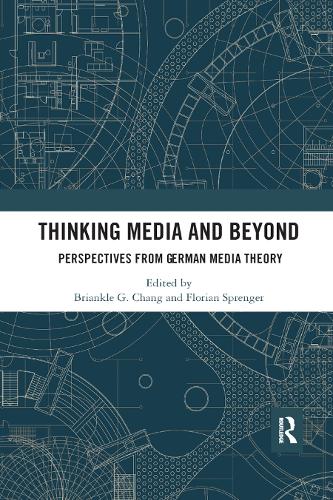
Thinking Media and Beyond :Perspectives from German Media Theory
paperback
Published:
17 December, 2019

Popular Books by Florian Sprenger
View All Books by Florian Sprenger
Description
Media – old or new, in the cloud or underground – constitutes the very condition in which our world takes shape. Media is reshaped continuously, marked for both the profound effects it produces and the acceleration it exhibits. It is the site in which we signal some of the most pressing issues we face in our ever-widening technologized world.
Written by authors working at the forefront of media theory today, this book charts an original and compelling path across various media forms, bringing to light the wonderful yet persistently unsettling role that media plays, and will continue to play, in the making of our future. It not only establishes media as a serious and interdisciplinary concept, but also demonstrates how this concept can be developed beyond the current limited form and content dichotomy.
This book was originally published as a special issue of Cultural Studies.
More Details
| Type | Book |
|---|---|
| ISBN13 | 9780367891862 |
| ISBN10 | 0367891867 |
| Number Of Pages | 172 |
| Item Weight | 453 g |
| Publisher / Reseller | Taylor & Francis Ltd |
| Format | paperback |
Author's Bio
Briankle G. Chang teaches Cultural Studies and Media Theory and Philosophy at the University of Massachusetts, USA. He is the author of Deconstructing Communication: Subject, Representation, and Economies of Exchange (1996) and co-editor of Philosophy of Communication (2012).
Florian Sprenger is Professor for Media and Cultural Studies at Goethe University, Germany. He is author of Politics of Microdecisions: Edward Snowden, Net Neutrality and the Architecture of the Internet (2015). His research covers topics such as the history of artificial environments and the media of immediacy.