Digital Twin for Smart Manufacturing
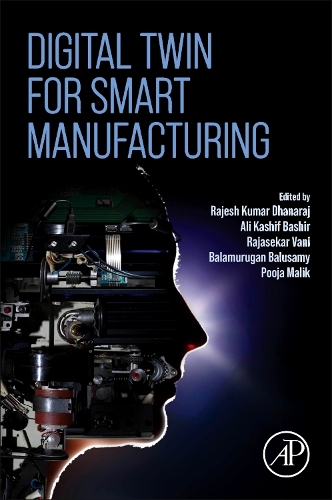
Digital Twin for Smart Manufacturing
paperback
Published:
24 August, 2023

Popular Books by Phd
View All Books by Phd








Description
More Details
| Type | Book |
|---|---|
| ISBN13 | 9780323992053 |
| ISBN10 | 0323992056 |
| Number Of Pages | 318 |
| Item Weight | 440 g |
| Publisher / Reseller | Elsevier Science & Technology |
| Format | paperback |
Author's Bio
Dr. Rajesh Kumar Dhanaraj is a professor at the Symbiosis International (Deemed University) in Pune, India. His research and publication interests include cyber-physical systems, wireless sensor networks, and cloud computing. He is a senior member of the Institute of Electrical and Electronics Engineers (IEEE), a member of the Computer Science Teacher Association (CSTA) and member of the International Association of Engineers (IAENG). He is an expert advisory panel member of Texas Instruments Inc. (USA), and an associate editor of International Journal of Pervasive Computing and Communications (Emerald Publishing). Ali Kashif Bashir is an Associate Professor at the School of Computing and Mathematics of Manchester Metropolitan University, United Kingdom, an Adjunct Professor at the School of Electrical Engineering and Computer Science at the National University of Science and Technology, Islamabad (NUST), Pakistan, an Honorary Professor at the School of Information and Communication Engineering of the University of Electronics Science and Technology of China (UESTC), and a Chief Advisor at the Visual Intelligence Research Center, UESTC, China. He is a senior member of the Institute of Electrical and Electronics Engineers (IEEE), United States and a distinguished speaker of the Association for Computing Machinery (ACM), United States. Vani Rajasekar is an Assistant Professor at the School of Computer Science and Technology at Kongu Engineering College. Her research focuses on network security and cryptography, and she has been published in 8 international journals, and presented at 8 international conferences. Dr. Balamurugan Balusamy is currently working as an Associate Dean Student in Shiv Nadar Institution of Eminence, Delhi-NCR. He is part of the Top 2% Scientists Worldwide 2023 by Stanford University in the area of Data Science/AI/ML. He is also an Adjunct Professor in the Department of Computer Science and Information Engineering, Taylor University, Malaysia. His contributions focus on engineering education, blockchain, and data sciences Pooja Malik is an Assistant Professor at the Department of Computer Science and Engineering at Shiv Nadar University, India. She teaches courses on computing and programming, data structures, and artificial intelligence, and her research interests include artificial intelligence, natural language processing, and machine learning.