Nano Technology for Battery Recycling, Remanufacturing, and Reusing - Micro & Nano Technologies
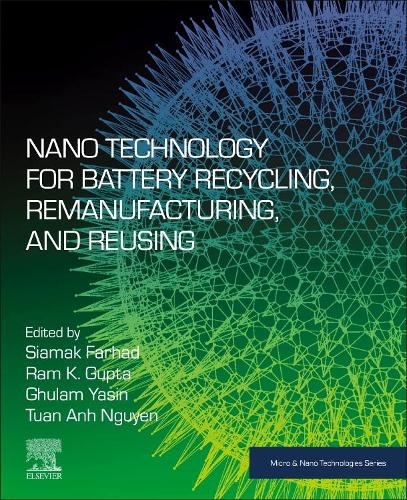
Nano Technology for Battery Recycling, Remanufacturing, and Reusing - Micro & Nano Technologies
paperback
Published:
29 April, 2022

Popular Books by Tuan Anh Nguyen
View All Books by Tuan Anh Nguyen
Description
More Details
| Type | Book |
|---|---|
| ISBN13 | 9780323911344 |
| ISBN10 | 032391134X |
| Number Of Pages | 520 |
| Item Weight | 1090 g |
| Publisher / Reseller | Elsevier - Health Sciences Division |
| Format | paperback |
Author's Bio
Siamak Farhad is Associate Professor in the Department of Mechanical Engineering, at The University of Akron, Ohio, USA. His primary and secondary research fields are energy and measurement, with a focus on energy, both energy conversion and storage, with particular emphasis on batteries, fuel cells, and piezoelectrics, from nano/microstructure design to the cell, device and system design. His focus in the field of measurement is on new sensors, is interdisciplinary and linked to nanotechnology, electrochemistry, thermal science, and material science. His research is based on both modeling and experiment; the selected research topics are, recycling and regeneration of lithium-ion battery materials, optimization of electrodes nano/microstructure for lithium battery, ceramic solid-state lithium battery, and piezoelectric materials for sensor and energy harvester. Ghulam Yasin is a researcher in the School of Environment and Civil Engineering at Dongguan University of Technology, Guangdong, China. His expertise covers the design and development of hybrid devices and technologies of carbon nanostructures and advanced nanomaterials for for real-world impact in energy-related and other functional applications. Tuan Anh Nguyen is a Senior Principal Research Scientist at the Institute for Tropical Technology, Vietnam Academy of Science and Technology, Hanoi, Vietnam. He received a BS in physics from Hanoi University in 1992, a BS in economics from Hanoi National Economics University in 1997, and a PhD in chemistry from the Paris Diderot University, France, in 2003. He was a Visiting Scientist at Seoul National University, South Korea, in 2004, and the University of Wollongong, Australia, in 2005. He then worked as a Postdoctoral Research Associate and Research Scientist at Montana State University, United States in 2006-09. In 2012 he was appointed as the Head of the Microanalysis Department at the Institute for Tropical Technology. His research areas of interest include smart sensors, smart networks, smart hospitals, smart cities, complexiverse, and digital twins. He has edited more than 74 books for Elsevier, 12 books for CRC Press, 1 book for Springer, 1 book for RSC, and 2 books for IGI Global. He is the Editor-in-Chief of Kenkyu Journal of Nanotechnology & Nanoscience. Ram Gupta is a Professor in the Department of Chemistry at Pittsburg State University, Kansas, United States. His research focus is in green energy production and storage using nanomaterials, optoelectronics and photovoltaics devices, organic-inorganic heterojunctions for sensors, nanomagnetism, conducting polymers and composites as well as bio-based polymers, bio-compatible nanofibers for tissue regeneration, scaffold and antibacterial applications, and bio-degradable metallic implants.