Mummies and Mortuary Monuments :A Postprocessual Prehistory of Central Andean Social Organization
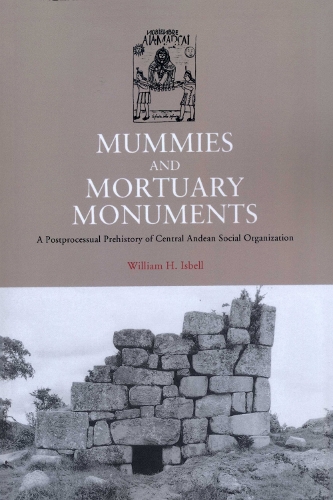
Mummies and Mortuary Monuments :A Postprocessual Prehistory of Central Andean Social Organization
paperback
Published:
1 October, 1997

Popular Books by William H. Isbell
View All Books by William H. Isbell
Description
Since prehistoric times, Andean societies have been organized around the ayllu, a grouping of real or ceremonial kinspeople who share labor, resources, and ritual obligations. Many Andean scholars believe that the ayllu is as ancient as Andean culture itself, possibly dating back as far as 6000 B.C., and that it arose to alleviate the hardships of farming in the mountainous Andean environment.
In this boldly revisionist book, however, William Isbell persuasively argues that the ayllu developed during the latter half of the Early Intermediate Period (around A.D. 200) as a means of resistance to the process of state formation. Drawing on archaeological evidence, as well as records of Inca life taken from the chroniclers, Isbell asserts that prehistoric ayllus were organized around the veneration of deceased ancestors, whose mummified bodies were housed in open sepulchers, or challups, where they could be visited by descendants seeking approval and favors. By charting the temporal and spatial distribution of chullpa ruins, Isbell offers a convincing new explanation of where, when, and why the ayllu developed.
More Details
| Type | Book |
|---|---|
| ISBN13 | 9780292717992 |
| ISBN10 | 0292717997 |
| Number Of Pages | 391 |
| Item Weight | 454 g |
| Publisher / Reseller | University of Texas Press |
| Format | paperback |
Media Reviews
"This book provides an excellent review of the concept of the ayllu and its relationship to ancestor worship, architectural features, farming and landholding, political organization, and resistance to the state... It will be a hotly discussed and possibly controversial book." --Clark L. Erickson, Associate Professor of Anthropology, University of Pennsylvania
Author's Bio
William H. Isbell is Professor and Chair of Anthropology at the State University of New York, Binghamton.