Popular Books by John Maeda
View All Books by John Maeda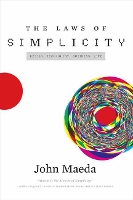





The Laws of Simplicity (Simplicity: Design, Technology, Business, Life)

The Laws of Simplicity (Simplicity: Design, Technology, Business, Life)
hardback
Published:
4 August, 2006

Description
More Details
| Type | Book |
|---|---|
| ISBN13 | 9780262134729 |
| ISBN10 | 0262134721 |
| Number Of Pages | 128 |
| Item Weight | 300 g |
| Product Dimensions | 144 x 14 x 210 mm |
| Publisher / Reseller | MIT Press |
| Format | hardback |
Media Reviews
Technology and life seem to be getting more complicated, yet two great success stories, Google and the iPod, both provide the antidote of simplicity. In The Laws of Simplicity, John Maeda uses humble prose to provide an accessible guide, business and life, observing the principle: 'Simplicity equals sanity.' -David Smith, The Observer
Abstract recommends this book particularly to marketing people, product designers and technical writers. -GetAbstract * Reviews *
FINALLY, a book about simplicity that is not too academic to read.... At the book's heart is the Shinto belief in animism, the spirit in all objects. Nicholas Negroponte, one of Maeda's mentors, once told him to become a lightbulb, not a laser beam. This he has done; all this and more. -Susan Salter Reynolds, The LA Times * Reviews *
John Maeda's new book, The Laws of Simplicity, is simply terrific. It's exactly 100 pages, the illustrations are brilliant and the 10 Laws of Simplicity (plus Three Keys) are a canon to design one's entire life, much less specific products, services or business models. The subtitle is: Design, Technology, Business, Life. -Bruce Nussbaum, BusinessWeek's blog NussbaumOnDesign * Reviews *
Keep it simple, Stupid' is an old piece of advice, so much so that it's often abbreviated as the 'KISS principle.' But it's advice that's often ignored, and MIT Professor John Maeda aims to change that.... Designers and marketers will find Maeda's book both interesting and useful.... -New York Post * Reviews *
Maeda's Laws and Keys have an obvious practical application in everyday running of a busy life (and desktop); they also have the potential to translate into a productive methodology for any craft or design practice.... A very humble, enlightened and caring human, John's written a little bible. -Liz Farrelly, Crafts Magazine * Reviews *
Maeda's upbeat explanations usefully break down the power of less-fewer features, fewer buttons and fewer distractions-while providing practical strategies for harnessing that power.... Emphasizing the delicate balance-work involved in simplifying the complex, Maeda admits the process isn't easy, and that his ten laws don't necessarily provide all the answers-in numerous places, he directs readers to the web site where his theories continue to develop. Despite that, this slim book feels complete in itself; not only will it stimulate ideas, it will keep readers thumbing back for a second and third look at Maeda's deceptively simple advice. -Publishers Weekly * Reviews *
Technology and life seem to be getting more complicated, yet two great success stories, Google and the iPod, both provide the antidote of simplicity. In The Laws of Simplicity, John Maeda uses humble prose to provide an accessible guide, business and life, observing the principle: 'Simplicity equals sanity.' -David Smith, The Observer * Reviews *
GoodReads Reviews
Author's Bio
An internationally recognized leader at the intersection of design and technology, John Maeda is Design Partner at the venture capital firm Kleiner Perkins Caufield & Byers in Silicon Valley. He served until 2014 as the 16th President of the Rhode Island School of Design (RISD) and before that was Associate Director of the MIT Media Lab. He is a designer, technologist, and catalyst behind the national movement to transform STEM (science, technology, engineering and math) to STEAM with the addition of the arts. He is the author of Design by Numbers (1999), The Laws of Simplicity (2006) and Redesigning Leadership (2011), all published by The MIT Press. An internationally recognized leader at the intersection of design and technology, John Maeda is Design Partner at the venture capital firm Kleiner Perkins Caufield & Byers in Silicon Valley. He served until 2014 as the 16th President of the Rhode Island School of Design (RISD) and before that was Associate Director of the MIT Media Lab. He is a designer, technologist, and catalyst behind the national movement to transform STEM (science, technology, engineering and math) to STEAM with the addition of the arts. He is the author of Design by Numbers (1999), The Laws of Simplicity (2006) and Redesigning Leadership (2011), all published by The MIT Press.