The Patient-Physician Relation :The Patient As Partner, Part 2 - Medical Ethics
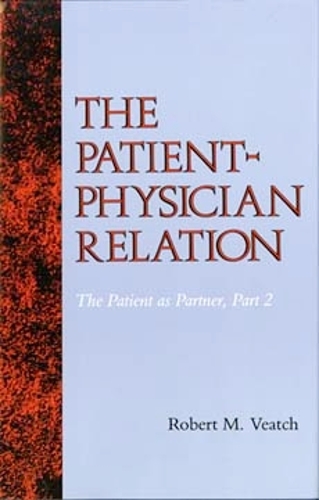
The Patient-Physician Relation :The Patient As Partner, Part 2 - Medical Ethics
hardback
Published:
22 January, 1991

Popular Books by Robert M. Veatch
View All Books by Robert M. Veatch


Description
"Throughout the past two decades, when medical ethics has had a renaissance, Robert Veatch has been a leading contributor to its dialogue and advance. This collection of his work shows the breadth and the cogency of his thinking. . . . it is a book worth having." —Journal of the American Medical Association
" . . . a fascinating dissection of almost every aspect of the doctor-patient relationship. . . . strongly recommended reading for all health care workers interested in this rapidly evolving field." —Queen's Quarterly
"This outstanding discussion of important current medical issues is a valuable addition to academic and professional libraries." —Choice
" . . . an important contribution to bioethics . . . certain to provoke controversy in the field." —Medical Humanities Review
"Lucid and well-argued . . . " —Religious Studies Review
This book heralds the imminent demise of "doctor knows best." In it, Robert M. Veatch proposes a postmodern medicine in which decisions about patient care will routinely involve both doctor and patient—not only in ethically complex cases such as the termination of life-sustaining treatment, but in everyday care as well.
More Details
| Type | Book |
|---|---|
| ISBN13 | 9780253362070 |
| ISBN10 | 0253362075 |
| Number Of Pages | 322 |
| Item Weight | 653 g |
| Publisher / Reseller | Indiana University Press |
| Format | hardback |
Media Reviews
"Veatch, an eminent medical ethicist, addressed the concept of a contractual physician—patient relationship applied to research settings in The Patient as Partner: A Theory of Human—Experimentation Ethics (CH, Sep'87). In this new volume he applies it to routine clinical encounters. Cogent arguments are presented to show the inappropriateness of traditional authoritarian interactions for modern clinical encounters. Chapters examine patients' values, the concept of medical indications (which Veatch argues contains embedded values and biases), and application of the proposed model to malpractice, generic prescribing, use of investigational drugs, drug use for nonapproved purposes, placebos, access to medical records, and notions of confidentiality and duty. Part 3 of the book includes four chapters dealing with the principle of justice, too often neglected in American writings about medical ethics. The work concludes with chapters dealing with special problems: transplantation, guardianship, do—not—resuscitate orders, and ethics committees. The final chapter summarizes and discusses these concepts in the context of medicine's changing technology and culture. This outstanding discussion of important current medical issues is a valuable addition to academic and professional libraries."—L. A. Crandall, University of Florida , Choice, September 1991