Natality and Finitude - Studies in Continental Thought
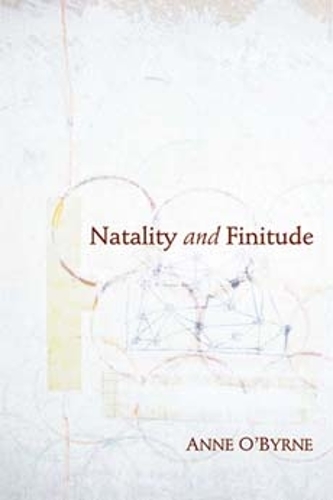
Natality and Finitude - Studies in Continental Thought
paperback
Published:
22 September, 2010

Popular Books by Anne O'Byrne
View All Books by Anne O'Byrne
Description
Philosophers are accustomed to thinking about human existence as finite and deathbound. Anne O'Byrne focuses instead on birth as a way to make sense of being alive. Building on the work of Heidegger, Dilthey, Arendt, and Nancy, O'Byrne discusses how the world becomes ours and how meaning emerges from our relations to generations past and to come. Themes such as creation, time, inheritance, birth and action, embodiment, biological determinism, and cloning anchor this sensitive and powerful analysis. O'Byrne's thinking advances and deepens important discussions at the intersections of feminism, continental philosophy, philosophy of religion, and social and political thought.
More Details
| Type | Book |
|---|---|
| ISBN13 | 9780253222411 |
| ISBN10 | 0253222419 |
| Number Of Pages | 218 |
| Item Weight | 340 g |
| Publisher / Reseller | Indiana University Press |
| Format | paperback |
Media Reviews
"O'Byrne (Stony Brook Univ.) argues for a rethinking of finitude in terms of birth (or 'natality') rather than the Heideggerian motifs of being-towards-death. Natality offers a positive way to understand finitude in terms of possibilities; this can be contrasted with Heidegger's emphasis on being-towards-death—the 'possibility of my impossibility'—where finitude is principally understood as the exclusion of possibilities. O'Byrne's book moves in five chapters, with an afterword. The first chapter doubles as an introduction. Chapter 2 offers the author's discussion of Heidegger. Chapter 3, one of the most interesting ones, turns to the work of Dilthey, and argues that Heidegger's critiques of Dilthey can be answered by emphasizing natality in his work. Chapter 4 focuses on Hannah Arendt, who coined the term natality. Chapter 5 discusses natality and finitude in the work of French philosopher Jean-Luc Nancy. The afterword concludes the book with a discussion of natality and human cloning. Summing Up: Recommended. Graduate students and researchers/faculty. —Choice"—B. T. Harding, Texas Woman's University, August 2011
"With great clarity and depth, Anne O'Byrne's new book, Natality and Finitude, explores a wide variety of themes, including birth, life, death, temporality, history, embodiment and reproduction. While O'Byrne never loses sight of the importance of identifying and exploring these themes as they occur throughout the Western philosophical tradition, her arguments are guided by the recent work on natality and finitude by Martin Heidegger, Wilhelm Dilthey, Hannah Arendt, and Jean-Luc Nancy."—Continental Philosophy Review
"O'Byrne argues for a rethinking of finitude in terms of birth (or 'natality') rather than the Heideggerian motifs of being-towards-death. Natality offers a positive way to understand finitude in terms of possibilities ... RecommendedVol. 48 No. 11 August 2011"—Choice
"The relevance of this book—to crucial debates in continental thought, feminism, and political philosophy—cannot be over-emphasized. O'Byrne is particularly generous to her colleagues; the text so brims with references to secondary literature that outline the major sources of input to the discussion. The endnotes point to lines of further research. The prose is generally clear, engaging, and insightful. This work shound not be overlooked. 1/26/2011"—Symposium, Canadian Journal for Continental Philosophy
"An extraordinary book, beautifully written, well argued."—Peg Birmingham, DePaul University
Author's Bio
Anne O'Byrne is Assistant Professor of Philosophy at Stony Brook University.