Three Loves for Three Oranges :Gozzi, Meyerhold, Prokofiev
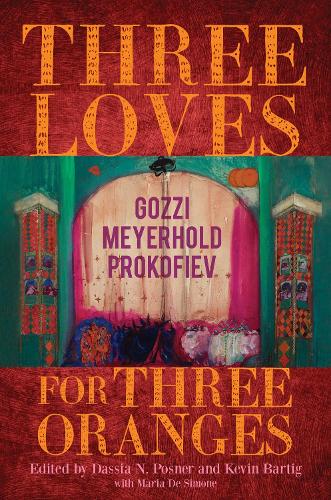
Three Loves for Three Oranges :Gozzi, Meyerhold, Prokofiev
hardback
Published:
14 September, 2021

Popular Books by Kevin Bartig
View All Books by Kevin Bartig
Description
In 1921, Sergei Prokofiev's Love for Three Oranges—one of the earliest, most famous examples of modernist opera—premiered in Chicago. Prokofiev's source was a 1913 theatrical divertissement by Vsevolod Meyerhold, who, in turn, took inspiration from Carlo Gozzi's 1761 commedia dell'arte–infused theatrical fairy tale. Only by examining these whimsical, provocative works together can we understand the full significance of their intertwined lineage.
With contributions from 17 distinguished scholars in theater, art history, Italian, Slavic studies, and musicology, Three Loves for Three Oranges: Gozzi, Meyerhold, Prokofiev illuminates the historical development of Modernism in the arts, the ways in which commedia dell'arte's self-referential and improvisatory elements have inspired theater and music innovations, and how polemical playfulness informs creation.
A resource for scholars and theater lovers alike, this collection of essays, paired with new translations of Love for Three Oranges, charts the transformations and transpositions that this fantastical tale underwent to provoke theatrical revolutions that still reverberate today.
More Details
| Type | Book |
|---|---|
| ISBN13 | 9780253057884 |
| ISBN10 | 0253057884 |
| Number Of Pages | 460 |
| Item Weight | 816 g |
| Publisher / Reseller | Indiana University Press |
| Format | hardback |
Media Reviews
Uniquely, this volume gives us innovative translations, detailed comparisons and interdisciplinary analyses of all three texts detailing the journey from Carl Gozzi's fiaba, through Meyerhold/Soloviev/Vogak's Divertissement, to Prokofiev's opera. Previous literature mapped some of the changes, but none offered the comprehensive analyses we find in this book. . . . The tripartite structure of the book is the most logical in terms of the material and, together with the cited paired chapters, as well as reading chapters as stand-alone texts, allow a multi-focus use both for the specialist and the general reader. The editors are to be congratulated for their overall innovative approach and for making the work of many Italian and Russian scholars available in English.
- F Jane Schopf (Stanislavski Studies)This is a delightful book, as scholarly in its method as it is light-hearted in its approach. It is also unique in that it brings together for the very !rst time in publication history three famous, but not fully excavated and known works by Carlo Gozzi, Vsevolod Meyerhold (together with Vladmir Solovyev and Konstantin Vogak), and Sergey Proko!ev.
- Maria Shevtsova (New Theatre Quarterly)A complex and rigorous exploration of the artistic lineages, Three Loves for Three Oranges: Gozzi, Meyerhold, Prokofiev offers a detailed study of the intertwined creative paths of Gozzi's theatrical fairy tale (fiaba), Meyerhold's divertissement, and Prokofiev's opera. This carefully conceived and elegantly executed collection of essays and originally translated theatrical texts is an immense multidisciplinary historiographic undertaking, which includes insightful contributions of seventeen scholars from the fields of theater and art history, Italian and Slavic Studies, and musicology. . . . Highlighting the importance of multiple cultural and disciplinary perspectives in historiographic research, the volume boldly paves the way for further investigations of theatrical genealogies.
- Julia Listengarten (The Russian Review)Author's Bio
Dassia N. Posner is Associate Professor of Theatre and Slavic Languages and Literatures at Northwestern University. Her books include The Director's Prism: E. T. A. Hoffmann and the Russian Theatrical Avant-Garde and The Routledge Companion to Puppetry and Material Performance.
Kevin Bartig is Professor of Musicology at Michigan State University. His books include Composing for the Red Screen: Prokofiev and Soviet Film and Sergei Prokofiev's Alexander Nevsky.
Maria De Simone is a PhD candidate in the Interdisciplinary PhD in Theatre and Drama (IPTD) program at Northwestern University. Maria also holds an MA from Ca' Foscari University of Venice, where she was first introduced to 18th-century Venetian theatrical practices.