The Heretic of Cacheu :Struggles over Life in a Seventeenth-Century West African Port
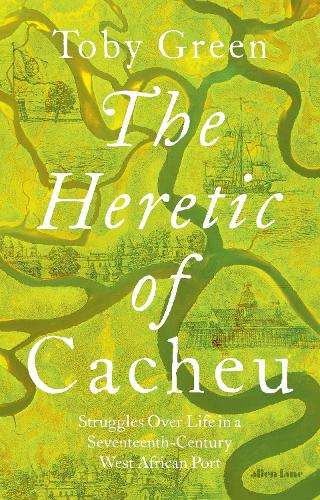
The Heretic of Cacheu :Struggles over Life in a Seventeenth-Century West African Port
hardback
Published:
3 July, 2025

Popular Books by Toby Green
View All Books by Toby Green

Description
'A stunning global history of West Africa ... with this new tour de force, Green confirms himself as the most innovative historian, writer, and thinker of his generation' Ana Lucia Araujo, author of Humans in Shackles: An Atlantic History of Slavery
A unique, startling book that gives a rich and detailed sense of life in an African port some 360 years ago
In 1665 Crispina Peres, the most powerful trader in the West African slave trafficking port of Cacheu, was arrested by the Inquisition. Her enemies had conspired to denounce her for taking treatments prescribed by Senegambian healers: the djabakós. But who was Peres? And why was the Portuguese Inquisition so concerned with policing the faith of a West African woman in today’s Guinea-Bissau?
In Cacheu Toby Green takes us to the heart of this conundrum, but also into the atmosphere of a very distant time and place. We learn how people in seventeenth-century Cacheu built their houses, what they wore, how they worshipped – and also the work they did, how they had fun, and how they healed themselves from illness.
Through this story, the haunting realities of the growing slave trade and the rise of European empires emerge in shocking detail. By the 1650s, the relationship between Europe, West Africa, and the Americas was already an old one, with slaving entrepots, colonies, and military bases interweaving over many generations. But Cacheu also challenged the dynamic. It was globally connected to places ranging from China and India to Brazil and Colombia, and women like Crispina Peres ran the town and challenged the patriarchy of empire.
For the first time, through the surviving documents recording Peres’s case, we can see what this world was really like. Cacheu is an extraordinary act of historical recovery. It is the story of a seventeenth-century West African woman, but also of the shifting, sophisticated world in which she lived – its beliefs, values and people.
More Details
| Type | Book |
|---|---|
| ISBN13 | 9780241611418 |
| ISBN10 | 0241611415 |
| Number Of Pages | 368 |
| Item Weight | 573 g |
| Product Dimensions | 165 x 242 x 32 mm |
| Publisher / Reseller | Penguin Books Ltd |
| Format | hardback |
Media Reviews
Staggering... He has performed an admirable work of historical reconstruction, despite the enduring difficulty of giving expression to African voices -- Michael Taylor * Literary Review *
A marvellously detailed account of life on the edge of what is now Guinea-Bissau... conjures up with wonderful vividness the sights and sounds of this distant world... Green knocks old myths on the head: that Africans typically had a “subsistence economy”, or lived static lives. He also highlights just how global the material world of these people already was -- Noel Malcolm * Daily Telegraph *
[This] painstakingly researched study recreates a world in which slavery was a significant but widely disavowed part of everyday life * History Today *
A stunning global history of West Africa, The Heretic of Cacheu weaves together the tragic histories of the Inquisition and the Atlantic slave trade. Drawing on archival research in three continents and presenting transformative new arguments in a profoundly moving narrative, with this new tour de force, Green confirms himself as the most innovative historian, writer, and thinker of his generation -- Ana Lucia Araujo, author of Humans in Shackles: An Atlantic History of Slavery
Toby Green has produced a book of rare distinction. Working across a range of inquisition sources, languages and spatial locations, he has shown the emotional effects of imperial slave trafficking on African inhabitants and colonial sojourners in Cacheu, modern-day Guinea-Bissau. To produce this remarkable book, he looks through the crystalline lens of the life story of the richest trader in the town, a woman called Crispina Peres. Green reveals human emotions by exhuming sources that catalogue daily lives governed by politics, fears, betrayal, treachery, promiscuity, affairs, revenge, cruelties, imprisonment and religious confessions. This is a substantial contribution to knowledge and our understanding of the social history of Africans and Europeans in seventeenth-century West Africa -- Dr. José Lingna Nafafé, author of Lourenço da Silva Mendonça and the Black Atlantic Abolitionist Movement in the Seventeenth Century
This book is more than a biography of a great West African settlement. It is also about how Cacheu held the keys to prosperity and progress for generations of Atlantic traders. As in his previous works, Toby Green has, again, given agency to the people of the West African Coast, in this particular case especially to Crispina Peres -- Hassoum Ceesay * Director General, National Centre of Arts and Culture, The Gambia *
A rich microhistory centring on the life story of a fascinating African woman -- Mariana P. Candido
The Heretic of Cacheu makes significant contributions to human philosophy, religion, and liberty... Green's work hums with moral urgency... Green returns the African woman to world history, not as a footnote but as a moral compass – a testimony to the power and beauty of religion and the humanity of power. The Heretic of Cacheu is thus both historical reconstruction and ethical reflection, a reclamation of Africa’s agency in the construction of modernity and a reminder to the world of women like Crispina Peres. In this sense, then, the book is not just about Atlantic history; it is a sobering reminder that the conscience of history remains with those who would not be silenced -- Toyin Falola
Author's Bio
Toby Green has worked widely with colleagues across Africa, organising events in collaboration with institutions in Angola, Ghana, Guinea-Bissau, Mozambique Sierra Leone and the Gambia. His books have been translated into twelve languages and include the award-winning A Fistful of Shells and (as co-editor) Guinea-Bissau: Micro-State to ‘Narco-State’. He writes extensively for the media, including in recent years London Review of Books, New Statesman, Prospect, and UnHerd. He has worked on curriculum change in the teaching of African history both in the UK and in West Africa, and has been a member of the UK government’s Model History Curriculum Advisory Group. He is a Fellow of the British Academy, and Professor of Precolonial and Lusophone African History and Culture at King’s College, London.