Jimmy Carter and China :Multilateral Competition in the Global Cold War - A Nancy Bernkopf Tucker and Warren I. Cohen Book on American–East Asian Relations
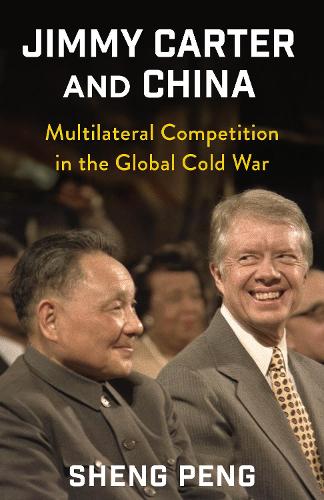
Jimmy Carter and China :Multilateral Competition in the Global Cold War - A Nancy Bernkopf Tucker and Warren I. Cohen Book on American–East Asian Relations
paperback
Published:
10 March, 2026

Popular Books by Sheng Peng
View All Books by Sheng Peng
Description
This book is an international history of the Carter administration’s intricate relations with the two competing Chinese regimes, highlighting the geopolitical significance and lasting implications of this pivotal moment. Drawing extensively from previously untapped archives in China, Taiwan, Western Europe, the United States, and Russia, Sheng Peng uncovers the internal governmental debates across world capitals that affected Carter’s China policy. He charts how both mainland China and Taiwan were integrated into global supply chains for defense and dual-use technologies during the 1970s and 1980s and the present-day consequences. Jimmy Carter and China demonstrates that technological competition was as crucial as strategic and ideological competition to the course of the Cold War, and together they profoundly shaped US-China relations and the world today.
More Details
| Type | Book |
|---|---|
| ISBN13 | 9780231211956 |
| ISBN10 | 0231211953 |
| Number Of Pages | 344 |
| Item Weight | 1000 g |
| Publisher / Reseller | Columbia University Press |
| Format | paperback |
Media Reviews
Sheng Peng has written a nuanced and balanced account of the Carter administration's policy toward China and Taiwan. Based on important research in Chinese and American source materials, it will be a crucial work for anyone who wants to understand the dilemmas that the United States faced in dealing with two competing Chinese governments. -- Gregg A. Brazinsky, author of Cold War Comrades: An Emotional History of the Sino-North Korean Alliance
A splendid account of a key phase in the US relationship with China and Taiwan. Using a wide array of previously unexamined primary sources, Sheng Peng gives us a fresh and deeply instructive take on the Carter administration’s multilayered approach to a multilateral competition. -- Fredrik Logevall, Harvard University
Sheng Peng’s important book shows how Jimmy Carter’s establishment of official US-China relations reshaped the Cold War by weakening the Soviet Union while accelerating China’s technological ascent and straining ties with Taiwan. Using sources from China, Taiwan, the United States, and from Europe and the Soviet Union, Peng reveals how decisions made in the late 1970s set the foundations of today’s US-China-Taiwan relationship. -- Pete Millwood, author of Improbable Diplomats: How Ping-Pong Players, Musicians, and Scientists Remade US-China Relations
Sheng Peng’s Jimmy Carter and China is required reading for students of the world’s most consequential bilateral relationship. Drawing on new American, Chinese, Soviet, and European materials, Peng reveals how America’s Cold War pivot toward Beijing helped to end the superpower conflict—and sowed the seeds for today’s conflicts. -- Timothy Nunan, University of Regensburg
Author's Bio
Sheng Peng is a postdoctoral fellow at the Research Center for the History of Transformations at the University of Vienna and an associate fellow at Harvard Kennedy School’s Belfer Center for Science and International Affairs.