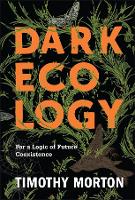
Dark Ecology :For a Logic of Future Coexistence - The Wellek Library Lectures
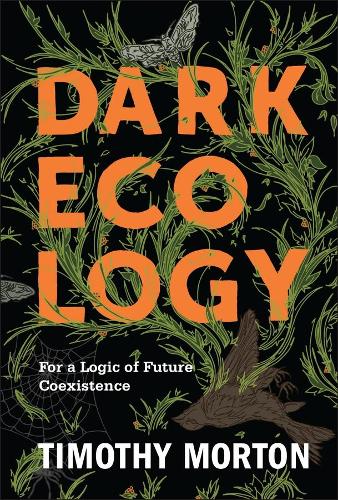
Dark Ecology :For a Logic of Future Coexistence - The Wellek Library Lectures
paperback
Published:
29 June, 2018

Popular Books by Timothy Morton
View All Books by Timothy Morton
Description
The logistics of agricultural society resulted in global warming and hardwired dangerous ideas about life-forms into the human mind. Dark ecology puts us in an uncanny position of radical self-knowledge, illuminating our place in the biosphere and our belonging to a species in a sense that is far less obvious than we like to think. Morton explores the logical foundations of the ecological crisis, which is suffused with the melancholy and negativity of coexistence yet evolving, as we explore its loop form, into something playful, anarchic, and comedic. His work is a skilled fusion of humanities and scientific scholarship, incorporating the theories and findings of philosophy, anthropology, literature, ecology, biology, and physics. Morton hopes to reestablish our ties to nonhuman beings and to help us rediscover the playfulness and joy that can brighten the dark, strange loop we traverse.
More Details
| Type | Book |
|---|---|
| ISBN13 | 9780231177535 |
| ISBN10 | 0231177534 |
| Number Of Pages | 208 |
| Item Weight | 1000 g |
| Publisher / Reseller | Columbia University Press |
| Format | paperback |
Media Reviews
In often witty and humorous language, Timothy Morton provides a kind of affective atlas for the human era. The book calls for scholars to recognize the structures of entwinement between (the human) species and ecological phenomena and to develop modes of thought for accommodating them. -- Kate Marshall, University of Notre Dame
Dark Ecology is a brave, brilliant interrogation of the presumptions that have driven our approach to the ecological and environmental challenges of our era. Anyone who is willing to ride the rollercoaster of ideas on which Morton takes us will reach the end brimming with new conceptual and intellectual energies with which to face up to our present limits and failures and to shape an alive and joyful future. -- Imre Szeman, University of Alberta
Morton is a master of philosophical enigma. In Dark Ecology he treats us to an obscure ecognosis, the essentially unsolvable riddle of ecological being. Prepare to be endarkened! -- Michael Marder, author of The Philosopher's Plant and Pyropolitics
Morton commands readers' attention with his free-form style.... [Dark Ecology] extends his previous work to offer a seismically different vision of the future of ecology and humankind. * Publishers Weekly *
With touches of humor, bits of information drawn from literature (ancient Latin and Greek), and plenty of philosophy, Morton takes readers on a strongly philosophical and semantic tour of 'the darkness and light' of human interrelatedness with the biosphere. * Choice *
A playful, poetic parsing of our era's environmental crisis. * Rice Magazine *
A rewarding hike. * Library Journal *
Timothy Morton's new work by turns fascinates, mystifies, stuns, confuses, and excites...Readers who seek new vocabularies for thinking about the Anthropocene and the vexed relation between human society and biological life will find a lot to work with. * British Society for Literature and Science *
[A] radical vision of what ecological thought can be. * Los Angeles Review of Books *
Morton’s provocative book urges the reader to braid, to twist, or to play cat’s cradle with its looping logic. * Critical Inquiry *
Morton disrupts the customary assumption that industrialization is the root cause of ecological crisis, such crisis being already contained in the agrilogistic drawing of a sharp boundary between human and nonhuman worlds. -- Charlene Elsby * The Canadian Society for Continental Philosophy *
GoodReads Reviews
Author's Bio
Timothy Morton is Rita Shea Guffey Chair in English at Rice University. His books include Ecology Without Nature (2007); The Ecological Thought (2010); Hyperobjects: Philosophy and Ecology After the End of the World (2013); and Realist Magic: Objects, Ontology, Causality (2013); and he has published more than 150 essays on ecology, philosophy, art, literature, music, architecture, and food. He has collaborated with several artists, including Björk, Jennifer Walshe, Olafur Eliasson, Haim Steinbach, Emilija Škarnulytė, and Pharrell Williams, and blogs regularly at ecologywithoutnature.blogspot.com.