Videophilosophy :The Perception of Time in Post-Fordism - Columbia Themes in Philosophy, Social Criticism, and the Arts
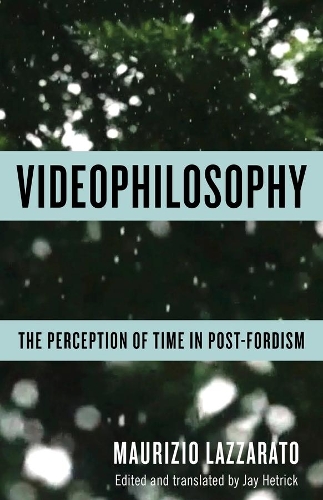
Videophilosophy :The Perception of Time in Post-Fordism - Columbia Themes in Philosophy, Social Criticism, and the Arts
paperback | English
Published:
26 February, 2019

Popular Books by Maurizio Lazzarato
View All Books by Maurizio Lazzarato

Description
Drawing on Bergson, Nietzsche, Benjamin, Deleuze and Guattari, and the film theory and practice of Dziga Vertov, Lazzarato constructs a new philosophy of media that ties political economy to the politics of aesthetics. Through his concept of “machines that crystallize time,” he argues that the proliferation of digital technologies over the past half-century marks the transition to a new mode of capitalist production characterized by unprecedented forms of subjection. This new era of the commodification of the self, Lazzarato declares, demands novel types of political action that challenge the commercialization and exploitation of time. This crucial text by an essential contemporary thinker offers vital new perspectives on aesthetics, politics, and media and critical theory.
More Details
| Type | Book |
|---|---|
| ISBN13 | 9780231175395 |
| ISBN10 | 0231175396 |
| Number Of Pages | 304 |
| Item Weight | 1000 g |
| Publisher / Reseller | Columbia University Press |
| Format | paperback |
Media Reviews
Like his comrade Antonio Negri, Maurizio Lazzarato has dedicated himself to exploring the less-traveled paths of modern thought in search of alternatives to capitalist modernity. In Videophilosophy, that exploration produces stunning results. Drawing on Bergson, Nietzsche, Vertov, Nam June Paik, and Bill Viola, Lazzarato constructs an innovative and compelling sequel to two of the most revolutionary texts in media studies: Gilles Deleuze's Cinema books and Walter Benjamin's 'The Work of Art in the Age of Its Technological Reproducibility.' -- Timothy Murphy, author of Antonio Negri: Modernity and the Multitude
This elegant translation makes available to Maurizio Lazzarato's growing English readership the theoretical cornerstone of his intellectual project, and puts into context his collaborative practice in video art. Videophilosophy makes an indispensable contribution to the philosophy of time and technology amidst and against the proliferation of contemporary capitalist subjectivities. -- Gary Genosko, author of When Technocultures Collide: Innovation from Below and the Struggle for Autonomy
How can time become crystallized in machines? From the cinematic image to the computational image of digital technologies, the artificial dilatation and construction of time has become equivalent to processes of thought. Videophilosophy takes you on a journey across these machinic syntheses of time, inaugurating a much-awaited media theory binding together materiality and technology in an unprecedented fashion. -- Luciana Parisi, author of Contagious Architecture. Computation, Aesthetics, and Space
Author's Bio
Maurizio Lazzarato is a philosopher and sociologist. In the 1970s, he was involved with the Autonomia Operaia movement in Italy and was a founding member of the French journal Multitudes. His books in English include Signs and Machines: Capitalism and the Production of Subjectivity (2014) and Governing by Debt (2015).
Jay Hetrick is assistant professor of art history and theory at the College of Fine Arts and Design, University of Sharjah.