Speculation, Trading, and Bubbles - Kenneth J. Arrow Lecture Series
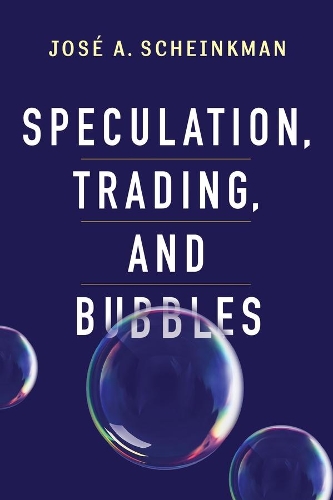
Speculation, Trading, and Bubbles - Kenneth J. Arrow Lecture Series
hardback
Published:
22 July, 2014

Popular Books by Jose A. Scheinkman
View All Books by Jose A. Scheinkman
Description
More Details
| Type | Book |
|---|---|
| ISBN13 | 9780231159029 |
| ISBN10 | 0231159021 |
| Number Of Pages | 128 |
| Item Weight | 1000 g |
| Publisher / Reseller | Columbia University Press |
| Format | hardback |
Media Reviews
There is much discussion about the impact of bubbles in financial markets and the policy challenges they create. This discourse is too often premised on informal and impressionistic notions of what constitutes a bubble. Jose A. Scheinkman's monograph pushes us to think more formally by providing an excellent discussion of explicit models of bubbles and their ramifications. This fascinating treatise is highly recommended. Readers will come away with a richer understanding of how some intriguing behavior in financial markets can be modeled in insightful ways. Moreover, they will better appreciate implications of these models for empirical evidence and policy guidance. -- Lars Peter Hansen, University of Chicago, winner of the Nobel Prize for Economics Jose A. Scheinkman has been at the forefront of financial economics for twenty-five years. This book introduces readers to his pioneering work: understanding how the rational and semirational collide in financial bubbles. It is elegantly written, insightful, fascinating-proof that the dismal science is moving toward a richer understanding of real markets, even at their most exuberant. -- Edward L. Glaeser, Harvard University, author of Triumph of the City This is a gem of a book on a topic of huge importance. Jose A. Scheinkman weaves through the logic of speculative bubbles, illustrating his arguments with clarity and precision yet always grounded in the institutions that form the backdrop for the financial system. It is the work of a masterful economist at the top of his game and should be read by anyone with an interest in connecting recent events to the timeless themes that feature in the history of the financial cycle. -- Hyun Song Shin, Princeton University Jose A. Scheinkman creates a fascinating model of bubbles fueled by differences in traders' beliefs. His analysis of traders' incentives to increase supplies in response to bubbles is full of implications about when to regulate derivatives and when to stand aside. Scheinkman's book is a masterpiece of theory and policy analysis, a fitting tribute to Kenneth J. Arrow. -- Thomas J. Sargent, New York University, winner of the Nobel Prize for Economics Investment professionals... might be intrigued by, if not convinced of, the regular pattern of [speculative trading] bubbles as presented in this short volume ... [these] discussions - involving Scheinkman and the eminent academics Kenneth Arrow, Patrick Bolton, Sanford Grossman, and Joseph Stiglitz - are worth the price of the book. Financial Analysts Journal
Author's Bio
Jose A. Scheinkman is the Edwin W. Rickert Professor of Economics at Columbia University and the Theodore Wells '29 Professor of Economics Emeritus at Princeton University. He is best known for his work on dynamic optimization, oligopoly theory, nonlinear dynamics, social interactions, and bubbles in financial markets. He is a member of the National Academy of Sciences and a Fellow of the Econometric Society and the American Academy of Arts and Sciences. Sandford J. Grossman is an American economist and hedge fund manager specializing in quantitative finance. He has published widely in leading economic and business journals, including American Economic Review, Journal of Econometrics, Econometrica, and Journal of Finance, and is chairman and CEO of QFS Asset Management. Patrick Bolton is the Barbara and David Zalaznick Professor of Business at Columbia Business School and a member of the Committee on Global Thought. He is also codirector of the Center for Contracts and Economic Organization at the Columbia Law School. His areas of interest are corporate finance, banking, sovereign debt, political economy, and law and economics.