Neuroscience and Philosophy :Brain, Mind, and Language
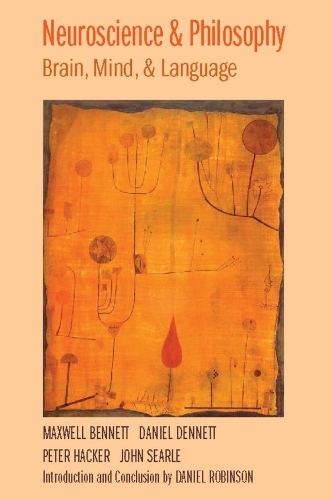
Neuroscience and Philosophy :Brain, Mind, and Language
paperback
Published:
4 March, 2009

Popular Books by Maxwell Bennett
View All Books by Maxwell Bennett


Description
More Details
| Type | Book |
|---|---|
| ISBN13 | 9780231140454 |
| ISBN10 | 0231140452 |
| Number Of Pages | 232 |
| Item Weight | 1000 g |
| Publisher / Reseller | Columbia University Press |
| Format | paperback |
Media Reviews
If you can get two sworn and unrestrained philosophical enemies such as Daniel Dennett and John Searle to join forces against you, you must at the very least be described as the controversialists of our time. -- Akeel Bilgrami, Johnsonian Professor of Philosophy and director, Heyman Centre for the Humanities, Columbia University Neurophysiology has made astonishing progress in recent decades and has learnt many hitherto unknown facts about the brain and its functioning. But what do these discoveries tell us about the mind? Peter Hacker and Maswell Bennett adopt an avowedly Aristotelian stance. Many cognitive scientists, they maintain, covertly endorse the dualism of Plato and Descartes, merely substituting brain-body dualism for mind-body dualism. If Daniel Dennett and John Searle are right, philosophical psychology is about to be superannuated by a scientific breakthrough in the study of the mind. If Bennett and Hacker are right, then much of cognitive neuroscience is not sound science but muddled philosophy. The resulting four-cornered discussion must rank as one of the great philosophical debates of our generation. The points at issue between these four sophisticated and articulate thinkers concern not only neurophysiology and philosophy of mind but the whole nature of philosophy itself and its relationship to science. The debates here give the reader an unparalleled chance to reach a personal decision on issues of fundamental intellectual importance. -- Anthony Kenny, Fellow Emeritus, St. John's College, Oxford University A useful introduction. -- Barry Dainton Science Readable and accessible. -- James Sage Metapsychology A good introduction to this dynamic subfield. Library Journal [A] rare opportunity to appreciate an encapsulated philosophical debate... Recommended. CHOICE
Author's Bio
Maxwell Bennett is professor of neuroscience and university chair at the University of Sydney and scientific director of the Brain and Mind Research Institute. His most recent books are History of the Synapse, The Idea of Consciousness, and Philosophical Foundations of Neuroscience, which he coauthored with Peter Hacker.Daniel Dennett is Austin B. Fletcher Professor of Philosophy and director of the Center for Cognitive Studies at Tufts University. He is the author of numerous books including Freedom Evolves, Breaking the Spell: Religion as a Natural Phenomenon, and Darwin's Dangerous Idea: Evolution and the Meanings of Life.Peter Hacker is a fellow of St. John's College, Oxford. The leading authority on the philosophy of Wittgenstein, his seventeen books include, most recently, Human Nature: The Categorical Framework, Philosophical Foundations of Neuroscience, which he coauthored with Maxwell Bennett, and Wittgenstein: Connections and Controversies.John Searle is Slusser Professor of Philosophy at the University of California, Berkeley. He is the author of sixteen books, including Freedom and Neurobiology: Reflections on Free Will, Language, and Political Power, Speech Acts: An Essay in the Philosophy of Language, and Mind: A Brief Introduction. His works have been translated into twenty-one languages, and in 2004 he was awarded the National Humanities Medal.