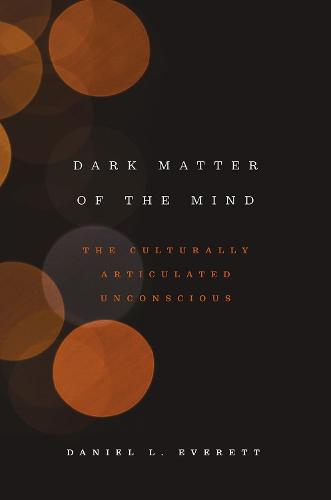
Dark Matter of the Mind :The Culturally Articulated Unconscious
Dark Matter of the Mind :The Culturally Articulated Unconscious
paperback
Published:
22 December, 2017

Popular Books by Daniel L. Everett
View All Books by Daniel L. Everett



Description
More Details
| Type | Book |
|---|---|
| ISBN13 | 9780226526782 |
| ISBN10 | 022652678X |
| Number Of Pages | 394 |
| Item Weight | 567 g |
| Product Dimensions | 15 x 23 x 2 mm |
| Publisher / Reseller | The University of Chicago Press |
| Format | paperback |
Media Reviews
A hit and the biggest wallop in the breadbasket Noam Chomsky's hegemony had ever suffered. --Tom Wolfe Harper's, on Don't Sleep There are Snakes
Everett begins by offering a fascinating argument: the only source of human learning is the individual--not in the mind, not in the brain, not in societies. Further, most of this learning is transmitted through culturally articulated dark matter, which he defines as any knowledge ... that is unspoken in normal circumstances, usually unarticulated even to ourselves. From this, Everett lays out his thesis in three parts: the human unconscious may be classified into the unspoken and the ineffable ; this unconscious is influenced by the interaction of human perception and a ranked-value, linguistic-based model of culture ; and that learning as cultural beings affects human thought and identity. Everett argues for and develops his thesis and its consequences in the remainder of the book. He makes a strong argument and brings in a wide-range of interesting anthropological case studies along the way. Recommended. --Choice
Everett takes us through the history of philosophy to show variations on those two themes as elaborated by the famous philosophers of the Western intellectual tradition, ending with his basically Aristotelian view, in contrast to the Chomskyan theory of innate structures and universal grammar. In the process, he challenges Freud's theory of the unconscious, Jung's archetypes, Bastien's psychic unity of man, Joseph Campbell's monomyth, and other variations on that theme. . . . What he says about this broad and multifaceted scope of human behavior is interesting and informative, and can be profitably read by anthropologists in all four fields of the discipline. --American Anthropologist
GoodReads Reviews
Author's Bio
Daniel L. Everett is the Dean of Arts and Sciences at Bentley University in Waltham, Massachusetts. He is the author of many books, including Don't Sleep, There Are Snakes; Language: The Cultural Tool; and Linguistic Fieldwork: A Student Guide. His life and work is also the subject of a documentary film, The Grammar of Happiness.