Unthought :The Power of the Cognitive Nonconscious
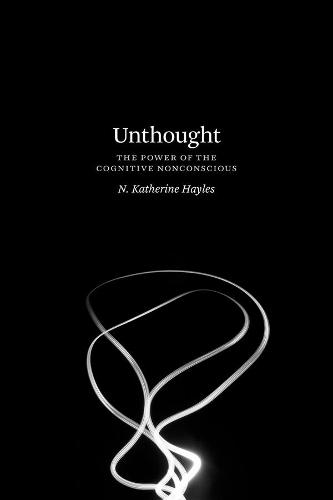
Unthought :The Power of the Cognitive Nonconscious
paperback
Published:
16 May, 2017

Popular Books by N. Katherine Hayles
View All Books by N. Katherine Hayles
Description
More Details
| Type | Book |
|---|---|
| ISBN13 | 9780226447889 |
| ISBN10 | 022644788X |
| Number Of Pages | 272 |
| Item Weight | 397 g |
| Product Dimensions | 16 x 23 x 2 mm |
| Publisher / Reseller | The University of Chicago Press |
| Format | paperback |
Media Reviews
Traditionally, we have associated cognition with consciousness and hence only with human beings. Unthought provides evidence from neuroscience, literary studies, economics, urban planning, robotics, computer science, and other fields to demonstrate that this narrow view is not only restrictive but dangerous. Hayles shows that if we think of cognition as pattern recognition and the capacity to respond to environmental changes, then most living things and many technical devices are cognizers. This cutting-edge, one-of-a-kind book offers a model of how to mediate between science and philosophy in an intelligent and respectful way. --Laura Otis, author of Rethinking Thought: Inside the Minds of Creative Scientists and Artists
No one has done more to integrate the two cultures than Katherine Hayles, and this volume is truly a signature achievement. Here she rethinks cognition, building an intricate theoretical assemblage that includes the new materialisms, neuroscience, and cognitive biology and opens up her recent analyses of 'how we think' to an entire planetary cognitive ecology that is as expansive as it is technically precise. It is also, importantly, deeply ethical, at a moment when the stakes for the humanities, and the world, are particularly high. Unthought marks a brilliant addition to Hayles's astonishing corpus--and it is surely destined to become part of our conscious and critical thought. --Rita Raley, author of Tactical Media
Author's Bio
N. Katherine Hayles is the James B. Duke Professor of Literature at Duke University. She is the author of many books, including, most recently, How We Think: Digital Media and Contemporary Technogenesis, also published by the University of Chicago Press.