The Rhapsodes :How 1940s Critics Changed American Film Culture
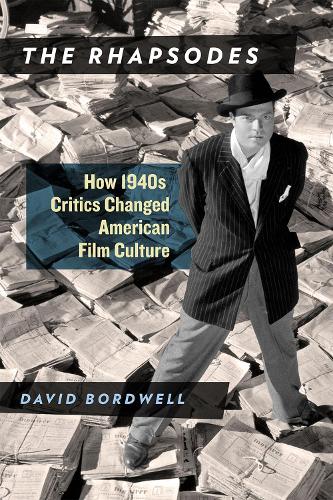
The Rhapsodes :How 1940s Critics Changed American Film Culture
paperback
Published:
29 April, 2016

Popular Books by David Bordwell
View All Books by David Bordwell

Description
With The Rhapsodes, renowned film scholar and critic David Bordwell—an heir to both those legacies—restores to a wider audience the work of Ferguson, Agee, Farber, and Tyler, critics he calls the “Rhapsodes” for the passionate and deliberately offbeat nature of their vernacular prose. Each broke with prevailing currents in criticism in order to find new ways to talk about the popular films that contemporaries often saw at best as trivial, at worst as a betrayal of art. Ferguson saw in Hollywood an engaging, adroit mode of popular storytelling. Agee sought in cinema the lyrical epiphanies found in romantic poetry. Farber, trained as a painter, brought a pictorial intelligence to bear on film. A surrealist, Tyler treated classic Hollywood as a collective hallucination that invited both audience and critic to find moments of subversive pleasure. With his customary clarity and brio, Bordwell takes readers through the relevant cultural and critical landscape and considers the critics’ writing styles, their conceptions of films, and their quarrels. He concludes by examining the profound impact of Ferguson, Agee, Farber, and Tyler on later generations of film writers.
The Rhapsodes allows readers to rediscover these remarkable critics who broke with convention to capture what they found moving, artful, or disappointing in classic Hollywood cinema and explores their robust—and continuing—influence.
More Details
| Type | Book |
|---|---|
| ISBN13 | 9780226352206 |
| ISBN10 | 022635220X |
| Number Of Pages | 176 |
| Item Weight | 284 g |
| Product Dimensions | 16 x 23 x 1 mm |
| Publisher / Reseller | The University of Chicago Press |
| Format | paperback |
Media Reviews
If you have a driving or even just a drive-by interest in arts criticism, film writing and the love we share for all kinds of movies, The Rhapsodes is a swift, terrific read. --Michael Phillips Chicago Tribune (04/26/2016)
The primary pleasure of this book comes from Bordwell s appreciation of the originality of these writers, the way each of them constructed a distinctive prose whose mixing of unlike elements calls to mind that homemade world that the critic Hugh Kenner discerned in the poetry of William Carlos Williams and Wallace Stevens. There is real enthusiasm, and valuable guidance, in Bordwell s tour, as he plucks out particularly lively or audacious passages. He walks us through the literature with an admirably light step, pointing out highlights and connecting dots, and, as he goes, filling in some of the background of the 1940s intellectual milieu in which these men worked. . . . The Rhapsodes elicits an awareness of just how much expressive energy was pouring out on the movie screens of America in pictures that many continued to regard as disposable time killers. --Geoffrey O'Brien Artforum (05/02/2016)
While each of the subjects of The Rhapsodes has come in for their appreciation in turn at one time or another, Bordwell s unique accomplishment is to situate them within the larger context of American arts journalism. . . . As one reasonably well-acquainted with all of Bordwell s Rhapsodes, much information here was new to me. . . . There are also Bordwell s typically lucid close reads of each writer s idiosyncratic style. . . . This slim volume is worth an even dozen critic memoirs and in recounting Ferguson s call to arms for a film criticism worthy of its subject, it sounds a reveille of its own. --Nick Pinkerton Sight & Sound (05/02/2016)
If you have a driving or even just a drive-by interest in arts criticism, film writing and the love we share for all kinds of movies, The Rhapsodes is a swift, terrific read. --Michael Phillips Chicago Tribune (04/26/2016)
The primary pleasure of this book comes from Bordwell's appreciation of the originality of these writers, the way each of them constructed a distinctive prose whose mixing of unlike elements calls to mind that homemade world that the critic Hugh Kenner discerned in the poetry of William Carlos Williams and Wallace Stevens. There is real enthusiasm, and valuable guidance, in Bordwell's tour, as he plucks out particularly lively or audacious passages. He walks us through the literature with an admirably light step, pointing out highlights and connecting dots, and, as he goes, filling in some of the background of the 1940s intellectual milieu in which these men worked. . . . The Rhapsodes elicits an awareness of just how much expressive energy was pouring out on the movie screens of America in pictures that many continued to regard as disposable time killers. --Geoffrey O'Brien Artforum (05/02/2016)
While each of the subjects of The Rhapsodes has come in for their appreciation in turn at one time or another, Bordwell's unique accomplishment is to situate them within the larger context of American arts journalism. . . . As one reasonably well-acquainted with all of Bordwell's Rhapsodes, much information here was new to me. . . . There are also Bordwell's typically lucid close reads of each writer's idiosyncratic style. . . . This slim volume is worth an even dozen critic memoirs--and in recounting Ferguson's call to arms for a film criticism worthy of its subject, it sounds a reveille of its own. --Nick Pinkerton Sight & Sound (05/02/2016)