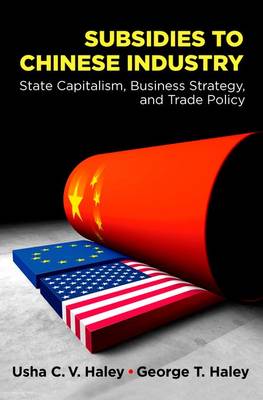
Subsidies to Chinese Industry :State Capitalism, Business Strategy, and Trade Policy
Subsidies to Chinese Industry :State Capitalism, Business Strategy, and Trade Policy
hardback
Published:
2 May, 2013
hardback
Published:
2 May, 2013

Standard worldwide delivery by
Tue, July 28 - Fri, July 31
Order within
0
Popular Books by Usha C.V. Haley
View All Books by Usha C.V. Haley

Description
How did China move so swiftly in capital-intensive industries without labor-cost or scale advantage from bit player to the largest manufacturer and exporter in the world? This book argues that subsidies contributed significantly to China's success. Industrial subsidies in key Chinese manufacturing industries may exceed thirty percent of industrial output. Economic theories have mostly portrayed subsidies as distortive, inefficiently reallocating resources according to non-market criteria. However, China's state-capitalist regime uses subsidies to promote the governments' and the Communist Party of China's interests. Rather than aberrations, subsidies help Chinese businesses and governments produce, stabilize and create common understandings of markets; the flows of capital reflect struggles between critical Chinese actors including central and provincial governments. Concepts of state capitalism including market-transition theory, the multi-organizational Chinese state, and state as paramount shareholder, create complex and relevant understandings of Chinese subsidies. The authors develop independent measures of industrial subsidies using publicly-reported data at firm and industry levels from governmental and private sources. Subsidies include free to low-cost loans, subsidies to energy (coal, electricity, natural gas, heavy oil) and to key inputs, land and technology. Four sequential studies identify the growth of subsidies to Chinese manufacturing over time and effects on world industry: steel (2000-2007), glass (2004-2008), paper (2002-2009) and auto parts (2001-2011). Subsidies to Chinese industry affect and are affected by business strategy and trade policy. Business strategies include lobbying for subsidies and for protection from subsidized foreign competitors and managing supply chains to guard against whiplash effects of uncoordinated subsidies. The subsidized solar industry highlights how global business strategies and decisions on production location and technology development respond to production or consumption subsidies and include market (competitive) and non-market (political) strategies. The book also covers government policies and regulation on subsidies broadly focusing on domestic consumption (antidumping and countervailing duties) and domestic production (indigenous innovation).
More Details
| Type | Book |
|---|---|
| ISBN13 | 9780199773749 |
| ISBN10 | 0199773742 |
| Number Of Pages | 272 |
| Item Weight | 517 g |
| Product Dimensions | 161 x 243 x 18 mm |
| Publisher / Reseller | Oxford University Press Inc |
| Format | hardback |
See More +
Media Reviews
A provocative new book* by Usha and George Haley, of West Virginia University and the University of New Haven respectively, points to another reason for China's industrial dominance: subsidies. * The Economist *
Author's Bio
UH: Asia Fellow, Ash Institute for Democratic Governance and Innovation, Harvard Kennedy School of Government and Research Associate, Economic Policy Institute in Washington, DCGH: Professor of Marketing & International Business, Director of Center for International Industry Competitiveness, University of New Haven