Coalitions of Convenience :United States Military Interventions after the Cold War
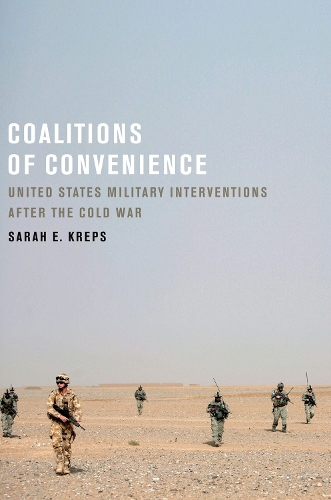
Coalitions of Convenience

Coalitions of Convenience :United States Military Interventions after the Cold War

paperback
Published: 3 February, 2011
Standard worldwide delivery by Tue, August 4 - Fri, August 7
Order within 0
Condition: NEW
$56.00
Price includes shipping
Available 20+ in stock
- +
FREE Returns within 30 days

Description

When the Clinton Administration sent the United States military into Haiti in 1994, it first sought United Nations authorization and assembled a large coalition of allies. With a defense budget 20 times the entire GDP of Haiti, why did the US seek multilateral support when its military could quickly and easily have overpowered the 7,600-soldier Haitian army? The US has enjoyed unrivaled military power after the Cold War and yet in eight out of ten post-Cold War military interventions, it has chosen to use force multilaterally rather than going alone. Why does the US seek allies when, as the case of Haiti so starkly illustrates, it does not appear to need their help? Why in other instances such as the 2003 Iraq War does it largely sidestep international institutions and allies and intervene unilaterally? In Coalitions of Convenience, Sarah E. Kreps answers these questions through a study of US interventions after the post-Cold War. She shows that even powerful states have incentives to intervene multilaterally. Coalitions and international organization blessing confer legitimacy and provide ways to share what are often costly burdens of war. But those benefits come at some cost, since multilateralism is less expedient than unilateralism. With long time horizons--in which threats are distant--states will welcome the material assistance and legitimacy benefits of multilateralism. Short time horizons, however, will make immediate payoffs of unilateralism more attractive, even if it means foregoing the longer-term benefits of multilateralism. Coalitions of Convenience ultimately shows that power may create more opportunities for states such as the US to act alone, but that the incentives are stacked against doing so. The implications of the argument go beyond questions of how the US uses force. They speak to questions about how the world works when power is concentrated in the hands of one state, how international institutions function, and what the rise of China and resurgence of Russia may mean for international cooperation and conflict.
See more

More Details

Type Book
ISBN13 9780199753802
ISBN10 0199753806
Number Of Pages 240
Item Weight 318 g
Product Dimensions 155 x 236 x 18 mm
Publisher / Reseller Oxford University Press Inc
Format paperback
See More +

Media Reviews

an important book, which deserves much attention .., well written and thoroughly researched, [and] which poses an important question and gives even more important answers. * Olivier Schmitt, International Affairs *
Students asking themselves why the post-Cold War global hegemon increasingly calls on support from other nations in its military engagements will benefit from reading Sarah E. Kreps Coalitions of Convenience * eInternational Relations *

Show more

Author's Bio

Sarah E. Kreps is an Assistant Professor in the Department of Government at Cornell University. She previously held fellowships at the Belfer Center for Science and International Affairs, Harvard University, and the Miller Center for Public Affairs, University of Virginia. Between 1999-2003, Kreps served as an active duty officer in the United States Air Force.

Show more