Objectivity and the Parochial
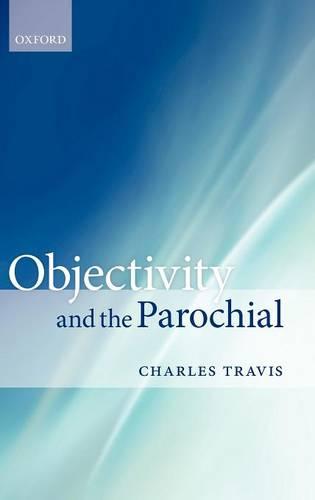
Objectivity and the Parochial
hardback
Published:
21 October, 2010

Popular Books by Charles Travis
View All Books by Charles Travis
Description
More Details
| Type | Book |
|---|---|
| ISBN13 | 9780199596218 |
| ISBN10 | 0199596212 |
| Number Of Pages | 370 |
| Item Weight | 730 g |
| Product Dimensions | 162 x 241 x 29 mm |
| Publisher / Reseller | Oxford University Press |
| Format | hardback |
Media Reviews
Traviss Objectivity and the Parochial is a collection of eleven previously published essays with a new introduction. The volume is philosophically generous, covering numerous themes including, but not limited to, logic and its laws, empiricism, idealism, psychologism, moral thought, thought and representation per se, truth, and the social character of thought. * Craig French, University of Cambridge, Mind Association *
Author's Bio
Charles Travis graduated in philosophy from University of California Berkeley in 1963. He received his doctorate from UCLA in 1967. In 1966 he began as an assistant professor at the University of North Carolina in 1967. Since then he has worked in 4 countries (plus several others as a visitor), and at quite a number of universities, most recently the University of Stirling, Northwestern University and King's College London. He has also visited at the University of Michigan and Harvard University, and lectured -- on Wittgenstein -- at the Collège de France. He is currently cooperating on projects in the University of Porto and the University of Santiago de Compostela.