For Peace and Money :French and British Finance in the Service of Tsars and Commissars - Oxford Studies in International History
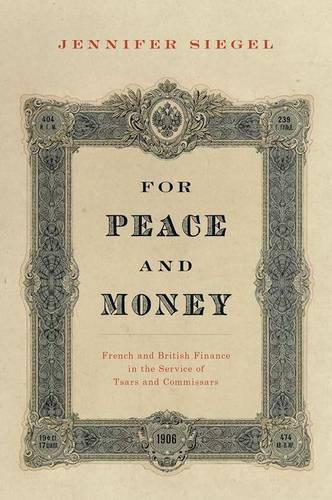
For Peace and Money :French and British Finance in the Service of Tsars and Commissars - Oxford Studies in International History
hardback
Published:
15 January, 2015

Popular Books by Jennifer Siegel
View All Books by Jennifer Siegel

Description
More Details
| Type | Book |
|---|---|
| ISBN13 | 9780199387816 |
| ISBN10 | 0199387818 |
| Number Of Pages | 328 |
| Item Weight | 558 g |
| Product Dimensions | 177 x 238 x 25 mm |
| Publisher / Reseller | Oxford University Press Inc |
| Format | hardback |
Media Reviews
This book's most important contribution is in uncovering the trove of documents in the archives of France, Great Britain, and, to a lesser extent, the United States. Russia's foreign loans and, in general, Russiaâs relationship with European financial institutions, have previously been the subjects of several important works, but none of them used such an array of archival materials in Europe. * Ekaterina Pravilova, The Russian Review *
Jennifer Siegel has written a gripping and entirely convincing narrative of the financial struggle that preceded the outbreak of war in 1914, and a fine account of the way in which a weak power used debt to manipulate the diplomacy of the stronger powers. * Harold James, Princeton University *
This is a fascinating and original work on the role of British and French finance in their relations with late-imperial but also early-Soviet Russia. Both diplomatic and financial history are unfashionable among contemporary Western historians: all the more refreshing therefore to read a truly path-breaking work dedicated to this topic. Professor Siegel brings to this study not just much research in a range of Russian and Western archives but also insights derived from her own first-hand experience of the financial world. Anyone interested in not just Russian history but also international relations in the era of the First World War should read this book. * Dominic Lieven, author of Towards the Flame: The End of Tsarist Russia *
Jennifer Siegel's superbly researched and powerfully argued monograph provides an exciting new perspective on the era of the First World War. For Peace and Money illuminates the crucial role played by financial diplomacy in the evolution of the Triple Entente before 1914, in the political dynamics of the Allied cause during the Great War, and in the international effort to rebuild European politics and society after that conflict. Siegel's highly original analysis challenges us to rethink the politics of indebtedness among Great Powers. The result is an ambitious reinterpretation of international relations during this period of profound upheaval and systemic change. * Peter Jackson, author of Beyond the Balance of Power: France and the Politics of National Security in the Era of the First World War *
In this important study, Siegel documents the role played by French and British lenders in underwriting Russia's transformation into a modern industrial and military power before World War I and the allies' financial support of the empire's participation in that conflict. Written in accessible prose and supported by impressive evidence from all three countries, this study reminds readers of the central role of finance in international relations, while showing them that its role is often more ambiguous than they might expect. * David McDonald, University of Wisconsin-Madison *
Author's Bio
Jennifer Siegel is an Associate Professor of History at Ohio State University and the author of Endgame: Britain, Russia and the Final Struggle for Central Asia (I.B. Tauris, 2002).