A Middle Class Without Democracy :Economic Growth and the Prospects for Democratization in China
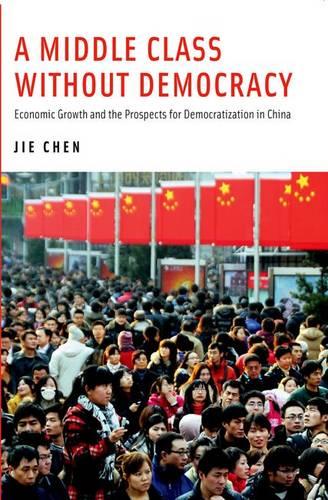
A Middle Class Without Democracy

A Middle Class Without Democracy :Economic Growth and the Prospects for Democratization in China

(Author)
paperback
Published: 11 September, 2014
Standard worldwide delivery by Tue, July 7 - Fri, July 10
Order within 0
Condition: NEW
$56.07
Price includes shipping
Available 20 in stock
- +
FREE Returns within 30 days

Description

What kind of role can the middle class play in potential democratization in such an undemocratic, late developing country as China? To answer this profound political as well as theoretical question, Jie Chen explores attitudinal and behavioral orientation of China's new middle class to democracy and democratization. Chen's work is based on a unique set of data collected from a probability-sample survey and in-depth interviews of residents in three major Chinese cities, Beijing, Chengdu and Xi'an--each of which represents a distinct level of economic development in urban China-in 2007 and 2008. The empirical findings derived from this data set confirm that (1) compared to other social classes, particularly lower classes, the new Chinese middle class-especially those employed in the state apparatus-tends to be more supportive of the current Party-state but less supportive of democratic values and institutions; (2) the new middle class's attitudes toward democracy may be accounted for by this class's close ideational and institutional ties with the state, and its perceived socioeconomic wellbeing, among other factors; (3) the lack of support for democracy among the middle class tends to cause this social class to act in favor of the current state but in opposition to democratic changes. The most important political implication is that while China's middle class is not likely to serve as the harbinger of democracy now, its current attitudes toward democracy may change in the future. Such a crucial shift in the middle class's orientation toward democracy can take place, especially when its dependence on the Party-state decreases and perception of its own social and economic statuses turns pessimistic. The key theoretical implication from the findings suggests that the attitudinal and behavioral orientations of the middle class-as a whole and as a part-toward democratic change in late developing countries are contingent upon its with the incumbent state and its perceived social/economic wellbeing, and the middle class's support for democracy in these countries is far from inevitable.
See more

More Details

Type Book
ISBN13 9780199385614
ISBN10 0199385610
Number Of Pages 240
Item Weight 340 g
Product Dimensions 231 x 155 x 15 mm
Publisher / Reseller Oxford University Press Inc
Format paperback
See More +

Media Reviews

... a valuable addition to the study of this important topic. It is written in a highly accessible manner that makes it well-suited for classroom use. * Bjorn Alpermann, Journal of Chinese Political Science *
sheds much-needed light on the stability of the political regime in China ... It is a must-read, not just for scholars studying China, but also for those academics interested in the political implications of economic transition in the former communist countries. * Ion Marandici, Europe-Asia Studies *

Show more

Author's Bio

Jie Chen is William Borah Distinguished Professor of Political Science, serves as Dean of the College of Graduate Studies at University of Idaho. He also holds the titles of the Changjiang Scholar Chair Professorship and Zhiyuan Chair Professorship bestowed, respectively, by the Ministry of Education, PRC, and by Shanghai Jiaotong University, China. He has authored and co-authored six books, including Popular Political Support in Urban China (Stanford University Press, 2004), and Allies of the State: China's Private Entrepreneurs and Democratic Change (with Bruce Dickson; Harvard University Press, 2010), and many articles, which appeared in scholarly journals, such as Journal of Politics, Comparative Political Studies, Public Opinion Quarterly, Social Science Quarterly, Political Research Quarterly, the China Quarterly, Asian Survey, Modern China, and Journal of Contemporary China.

Show more