Twenty Years After Communism
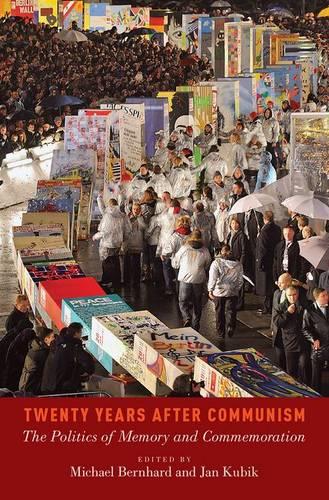
Twenty Years After Communism
paperback
Published:
21 August, 2014

Popular Books by Michael Bernhard
View All Books by Michael Bernhard

Description
More Details
| Type | Book |
|---|---|
| ISBN13 | 9780199375141 |
| ISBN10 | 0199375143 |
| Number Of Pages | 384 |
| Item Weight | 522 g |
| Product Dimensions | 155 x 249 x 25 mm |
| Publisher / Reseller | Oxford University Press Inc |
| Format | paperback |
Media Reviews
Remembering a nation's past shapes its future. We should know this in our bones, but thanks to Bernhard, Kubik, and their contributors, we have both theory and method to approach it analytically across the world, and inspired empirical studies of the post-communist world. One of the best volumes I have read in years. It is required reading for those who want to understand how cultural politics matter. * Michael D. Kennedy, Professor of Sociology and International Studies, Brown University *
In contrast to most studies of collective memory, which usually focus on one or a small handful of cases, Twenty Years After Communism systematically compares 17 cases of Eastern European memory of 1989. In order to do so, it develops a rigorous theoretical framework for studying 'official memory' in postcommunist countries. Both its conceptual introduction and the individual chapters mark a significant advance in social scientific memory studies and in understanding of this crucial region. It is sure to be a landmark volume. * Jeffrey K. Olick, Professor of Sociology and History, University of Virginia *
Memory studies' has become a crowded area of scholarship, with much rather sentimental work and too many books mechanically reproducing existing approaches. This volume is different: it offers an original theory of 'memory regimes' and uses it to compare the commemorations of 1989 across Central and Eastern Europe. The resulting chapters are a treasure trove of insights into the political cultures of post-communist countries. * Jan-Werner Muller, Professor of Politics, Princeton University *
provides in-depth expertise on the politics of memory and commemoration in 17 countries * Ferenc Laczó, Europe-Asia Studies *
Author's Bio
Michael Bernhard is Raymond and Miriam Ehrlich Chair of Political Science at the University of Florida. Jan Kubik is Professor and Chair of Political Science at Rutgers University.