The Opening of American Law :Neoclassical Legal Thought, 1870-1970
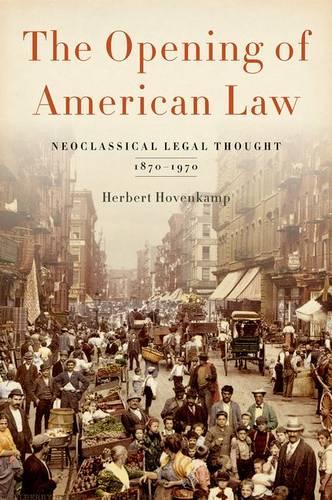
The Opening of American Law

The Opening of American Law :Neoclassical Legal Thought, 1870-1970

hardback
Published: 13 November, 2014
Standard worldwide delivery by Wed, August 5 - Mon, August 10
Order within 0
Condition: NEW
$124.09
Price includes shipping
Available 20+ in stock
- +
FREE Returns within 30 days

Description

Two Victorian Era intellectual movements changed the course of American legal thought: Darwinian natural selection and marginalist economics. The two movements rested on fundamentally inconsistent premises. Darwinism emphasized instinct, random selection, and determinism. Marginalism emphasized rational choice. Legal theory managed to accommodate both, although to different degrees in different disciplines. The two movements also developed mutually exclusive scientific methodologies. Darwinism emphasizing external indicators of welfare such as productivity, education or health, while marginalists emphasized market choice. Historians have generally exaggerated the role of Darwinism in American legal thought, while understating the role of marginalist economics. This book explores these issues in several legal disciplines. One is Progressive Era movements for redistributive policies about taxation and public goods. Darwinian science also dominated the law of race relations, while criminal law reflected an inconsistent mixture of Darwinian and marginalist incentive-based theories. The common law, including family law, contract, property, and tort, moved from emphasis on correction of past harms to management of ongoing risk and relationship. A chapter on Legal Realism emphasizes the Realists' indebtedness to institutional economics, a movement that powerfully influenced American legal theory long after it fell out of favor with economists. Five chapters on the corporation, innovation and competition policy show how marginalist economics transformed business policy. The ironic exception was patent law, which developed in relative insulation from economic concerns about innovation policy. The book concludes with three chapters on public law, emphasizing the role of institutionalist economics in policy making during and after the New Deal. A lengthy epilogue then explores the variety of postwar attempts to reconstruct a defensible and more market-oriented rule of law after the decline of Legal Realism and the New Deal.
See more

More Details

Type Book
ISBN13 9780199331307
ISBN10 0199331308
Number Of Pages 472
Item Weight 762 g
Product Dimensions 165 x 240 x 36 mm
Publisher / Reseller Oxford University Press Inc
Format hardback
See More +

Media Reviews

The main reason why I found The Opening of American Law fascinating and worth reading is that it clearly demonstrates the strength and resilience of classical political economy in affecting American law, even long after the approach had been challenged, and eventually displaced, by alternative theoretical paradigms. * Nicola Giocoli (University of Pisa), Journal of the History of Economic *
It is not often that a book offers a broad intellectual history of how the social sciences influence the development of law and legal thought. However, this is exactly what Professor Hovenkamp does in his latest book about the intellectual history of American law. Overall, this book would be a very useful complement to courses on comparative law, antitrust, and law and economics courses. * Andrés Palacios Lleras, World Competition Law and Economics Review *

Show more

Author's Bio

Herbert Hovenkamp is the Ben V. & Dorothy Willie Professor of Law and History, University of Iowa, where he teaches antitrust, torts, American legal history, and innovation policy. He has written numerous books in the these areas, and is the author of Antitrust Law, the leading resource in that field. He is a fellow of the American Academy of Arts and Sciences.

Show more