Fighting Poverty in the US and Europe :A World of Difference - The Rodolfo De Benedetti Lecture Series
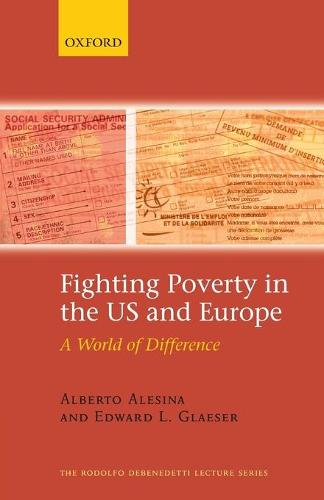
Fighting Poverty in the US and Europe :A World of Difference - The Rodolfo De Benedetti Lecture Series
paperback
Published:
10 November, 2005

Popular Books by Alberto Alesina
View All Books by Alberto Alesina
Description
More Details
| Type | Book |
|---|---|
| ISBN13 | 9780199286102 |
| ISBN10 | 0199286108 |
| Number Of Pages | 264 |
| Item Weight | 341 g |
| Product Dimensions | 137 x 216 x 15 mm |
| Publisher / Reseller | Oxford University Press |
| Format | paperback |
Media Reviews
... remarkable book ... Mr Alesina and Mr Glaeser, both Harvard economists, are doing what the best in their profession do well these days: seeking to explain society not merely with conventional economic tools but with analysis of institutions, geography and social behaviour. * The Economist 12 March 2004 *
In what ways, and why, are the United States and Europe so far apart in social policy? Alesina and Glaeser give us as definitive an answer to this fundamental question as we shall ever see. * George A. Akerlof, Nobel Prize Laureate *
This probing of the forces behind 'American exceptionalism', as measured by a much smaller welfare state than in Europe, is immensely important. The authors take a multi-discipline approach and consider many factors, including narrowly economic variables, political institutions, racial and ethnic diversity, the effects of wars, attitudes toward the poor, and still others. Their findings are sometimes surprising and frequently provocative. This monograph will quickly become the foundation of further literature on a subject of enormous significance. * Gary S. Becker, Nobel Prize Laureate *
Author's Bio
Alberto Alesina is Nathaniel Ropes Professor of Political Economy and currently Chairman of the Department of Economics at Harvard University, and has been Visiting Professor at IGIER-Bocconi and MIT. He is a Research Associate for the National Bureau of Economic Research and for the Centre for Economic Policy Research. He is Co-editor of the Quarterly Journal of Economics, and in addition to his many books and papers he has published columns in the Financial Times, the Wall Street Journal Europe, Le Monde, Il Sole 24 Ore, La Stampa, Frankfurter Zeitung, and Handelsblatt, and many other newspapers nationwide. Edward L. Glaeser is a Professor of Economics at Harvard University, where he has taught since 1992. He teaches urban and social economics and microeconomic theory, and has published dozens of papers on cities, economic growth, and law and economics. He is a Faculty Research Fellow for the National Bureau of Economic Research, and has also been a consultant for numerous international international institutions.